
Interview with Mao Baran, the solo founder who grew a mobile app to $20K/month

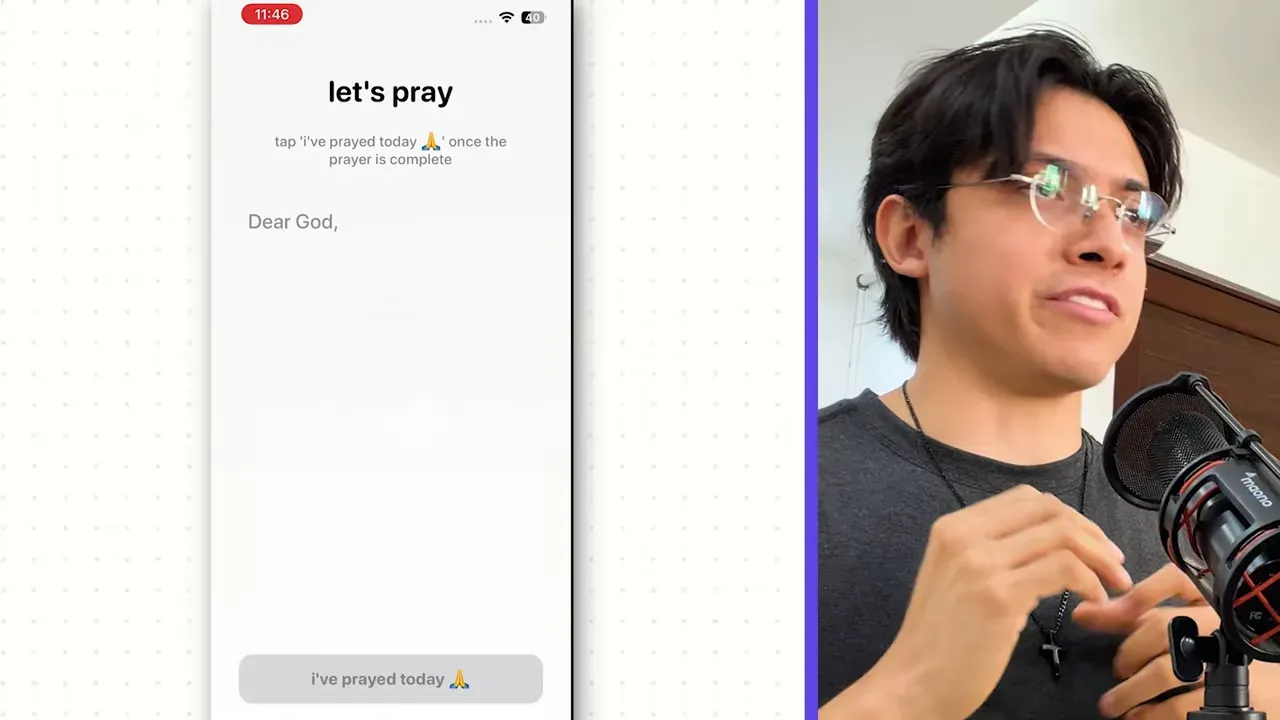
Table of Contents
- 📌 Why this story matters
- 🛠 The setup: what Mao built and how he priced it
- 🧱 The build: three days of coding, one week to app store approval
- 🚀 Growth fundamentals: distribution first, product second
- 📈 Paid ads and scaling: how reaction videos paid off
- 🧾 The stack and recurring costs
- 🧭 A concise playbook: what he would do if starting over in 2026
- 🧪 The onboarding secret
- 🤖 Tools, prompts, and cheap tricks for builders
- 📌 A small demo of the product flow
- ⚖️ Reality check: what worked and what was risky
- 🔁 Bringing it back to the primary tactic: AI-powered launch system for creators 🚀
- 📚 FAQ — quick answers for the impatient
- 🧾 Final verdict and next steps
📌 Why this story matters
Roger Mendoza lays out the practical bit: this is an example of an AI-powered launch system for creators that did not start with a fancy incubator, an agency retainer, or a polished design agency. It started as a focused, simple app and scaled through relentless distribution and surgical use of ads. The appeal is obvious to solo builders: rebuild an existing idea, ship fast, obsess over onboarding, and throw predictable ad money at formats that already work.
🛠 The setup: what Mao built and how he priced it
Who is Mao and what did he build?
Mao Baran is a self-taught builder who shifted from finance to AI and apps. He built a simple Christian habit app called Prayer Lock that blocks certain apps until a user offers a short, AI-generated prayer. It is subscription-based and intentionally minimal: a yearly plan for $49.99 and a weekly option at $9.99.
Within six months Prayer Lock reached roughly 58,000 downloads, about 6,700 App Store reviews, and a 4.9-star rating. Monthly revenue scaled quickly: around $10K in October, $15K in November, and about $21K in December — a steady month-over-month growth of roughly 50 percent.
🧱 The build: three days of coding, one week to app store approval
How did Mao actually code this? Did he hire a team?
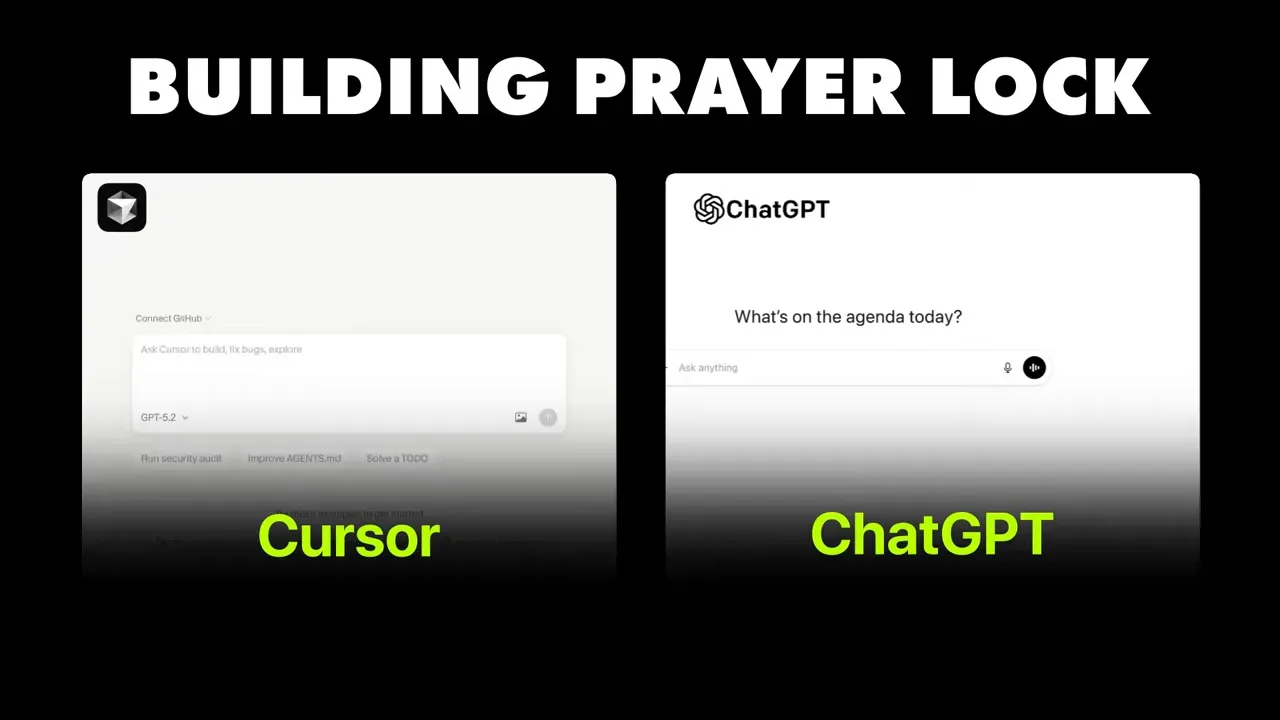
Mao built the app himself. He used AI-first development tools — primarily Cursor as the daily IDE and ChatGPT for debugging and small feature tweaks. He leveraged the Codex CLI for heavier tasks and leaned on small utilities for design iteration. The full MVP was prototyped and coded in about three days. Submission and app store approval took an extra week.
He emphasizes two practical constraints that kept the project lean:
- No mock-ups, no perfection theater: instead of designing polished screens first, he assembled the best onboarding patterns from existing apps into a Canva file and copied the patterns that worked.
- Minimal backend: no authentication, no remote database. Everything saved locally to minimize friction and hosting costs. His logic: momentum and conversion beat theoretical edge cases like phone switching for most users.
🚀 Growth fundamentals: distribution first, product second
How did Mao find traction at the start?
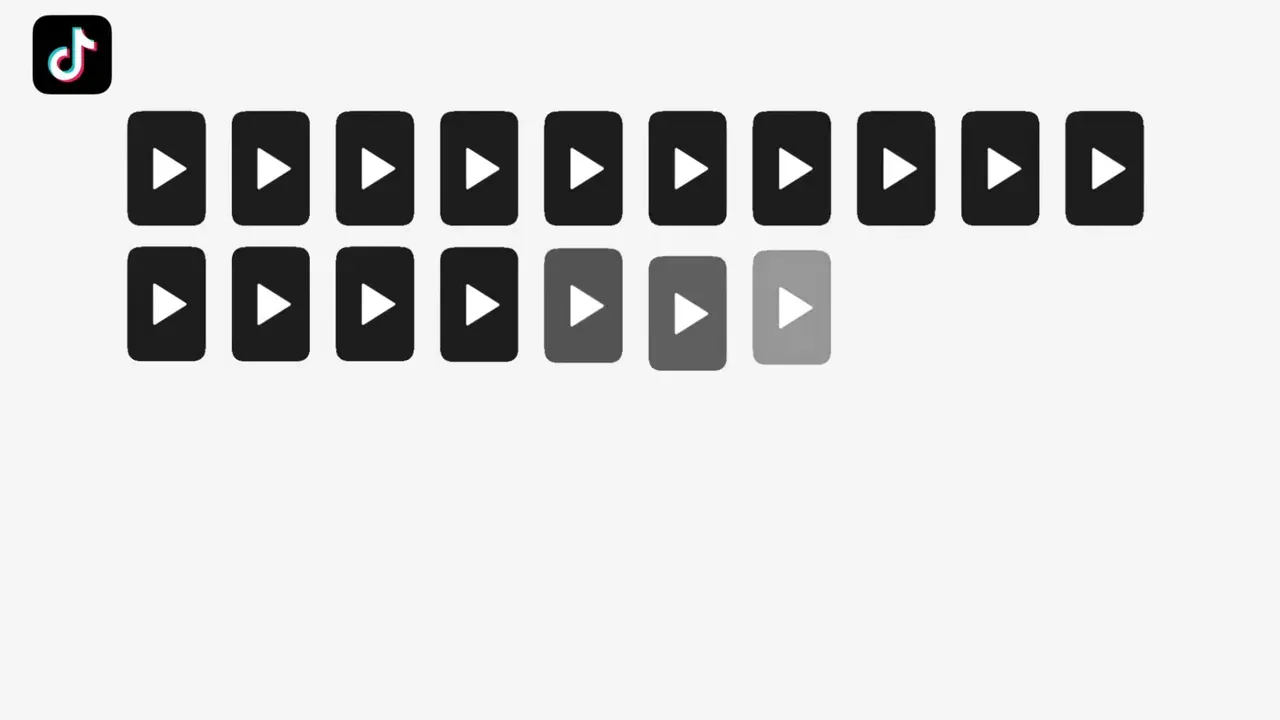
Mao treated content like a laboratory. Early on he posted massively — as many as 40 posts a day across multiple accounts — to test formats. The breakthrough came with a simple repeatable format: a UGC-style "girl reaction" demo that showcased the app in punchy, relatable clips. His wife helped record early videos, which scaled until the format found product-market fit for downloads.
He learned two important mapping metrics quickly:
- 10,000 views per day of the right format translated to roughly 200–300 downloads a day for his funnel.
- Consistency matters. Once a format worked, doubling down on it was orders of magnitude more valuable than chasing new formats.
📈 Paid ads and scaling: how reaction videos paid off
When did paid ads enter the playbook and what changed?
Mao tried influencer promotion and ran into the common trap: a single influencer post that flops doesn't disprove a channel. He experimented with Meta first, which produced mediocre results and exposed weaknesses in the onboarding. After simplifying and lengthening the onboarding experience — from about a five-minute flow to a 15-minute, storytelling-first flow — conversions improved dramatically.
TikTok Spark Ads became the multiplier. Mao reused his top-performing UGC reaction videos inside very broad TikTok campaigns (location restricted to the U.S., otherwise no narrow audience targeting). Results:
- Early TikTok tests returned around $4 per trial start when the yearly product value was $50.
- When a paid UGC creator produced consistent 10K-view organic videos, switching those assets to Spark Ads dropped cost per trial to $3 or less.
- He reinvested ad profits aggressively — an additional $4K then $6K in ad spend — which drove October to $10K, November to $15K, and December to $21K.
🧾 The stack and recurring costs
What tools and services powered the app and growth stack?
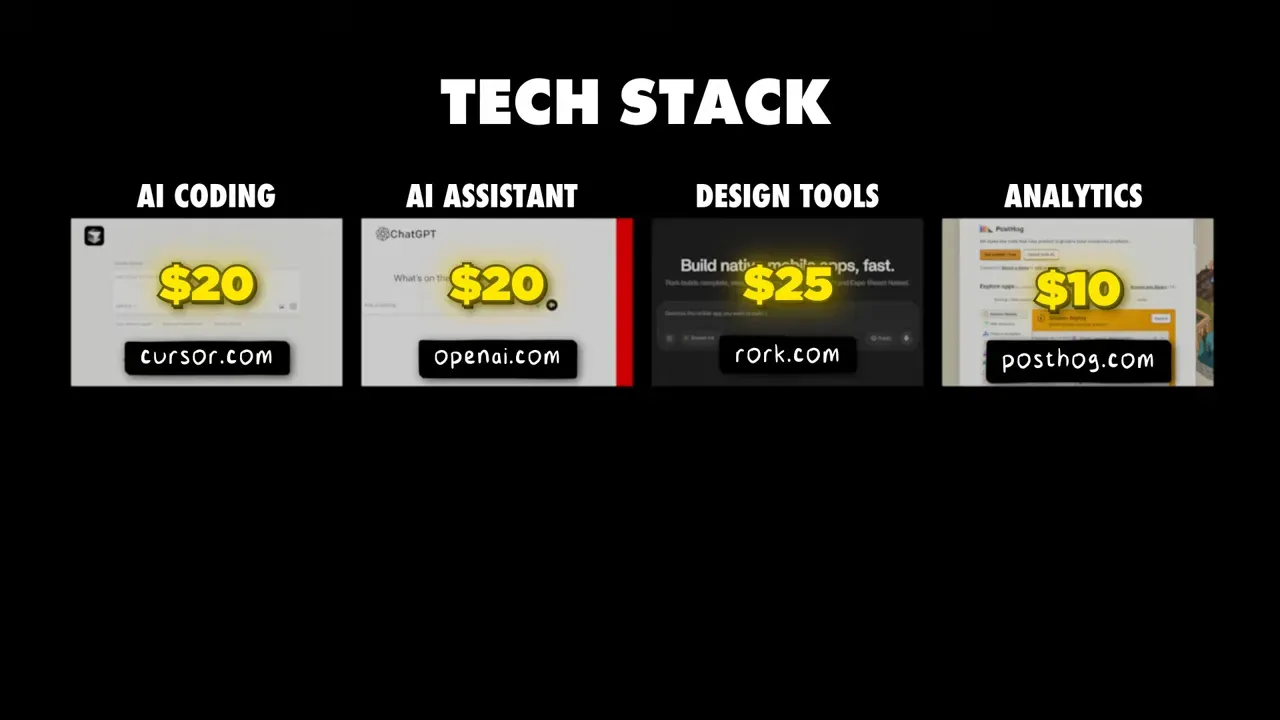
Mao kept costs low and choices pragmatic. The recurring stack looked like this:
- Cursor for development (around $20/month) and Codex CLI for heavier tasks.
- ChatGPT as a copiloting assistant for debugging and quick code changes.
- RorC for rapid design iteration ($25/month).
- PostHawk for analytics (about $10/month) and Superwall for paywalls (charge per conversion).
- Singular as the MMP for attribution and ad performance (low per-conversion fee after free tier).
- AWS for minimal hosting (effectively near-zero cost for his needs).
- Google Gemini Flash 2.5 for in-app AI generation (around $9/month).
Ads were the single largest spend. In December Mao spent roughly $9,000 on ads and averaged about $360/day. His reported cost per trial was about $1.88 in late December, meaning the paid channel was both predictable and profitable when the onboarding converted at scale.
🧭 A concise playbook: what he would do if starting over in 2026
What’s the step-by-step playbook for a solo builder today?
Mao boiled it down to an actionable checklist people can test this week. Roger paraphrases the steps with a little extra skepticism and sanity checks:
- Find a niche that already makes money: use tools like Sensor Tower to find apps doing $50K+/month and reverse-engineer their product and distribution.
- Pick an app and improve it: don’t invent the category; make the proven thing better and simpler.
- Ship fast: code the MVP in under two weeks. Set that limit or you’ll over-engineer forever.
- Don’t tweak product until you validate distribution: obsess over growth and content for the first months rather than polishing features.
- Optimize onboarding relentlessly: target at least a 10 percent download-to-trial conversion before scaling paid channels.
- Scale ad spend on proven organic creatives: once a video hits 10K+ organic views, promote it with Spark Ads on TikTok rather than reinventing creative.
🧪 The onboarding secret
What does Mao mean by “iterate on onboarding like crazy”?
Mao observed that the longer, story-driven onboarding worked better than a minimal sign-up flow. He intentionally stretched onboarding to build a narrative and perceived value: ask the right questions, show what happens next, and make the user say “yes” to the product mentally before they pay. That psychological commitment converted at a much higher rate when used with targeted paid traffic.
🤖 Tools, prompts, and cheap tricks for builders
How should solo builders use AI without wasting money?
Mao warns against the “one-shot” approach to AI. The model isn’t perfect enough to generate a flawless app from a single prompt. Instead:
- Break the app into small blocks and prompt the model for discrete features or screens.
- Use different tools for different jobs to avoid token overuse — Cursor for development, ChatGPT for Q&A, Codex CLI for complex code generation.
- Ship with local storage and no authentication where appropriate to cut costs and reduce friction.
📌 A small demo of the product flow
What does the user experience look like?
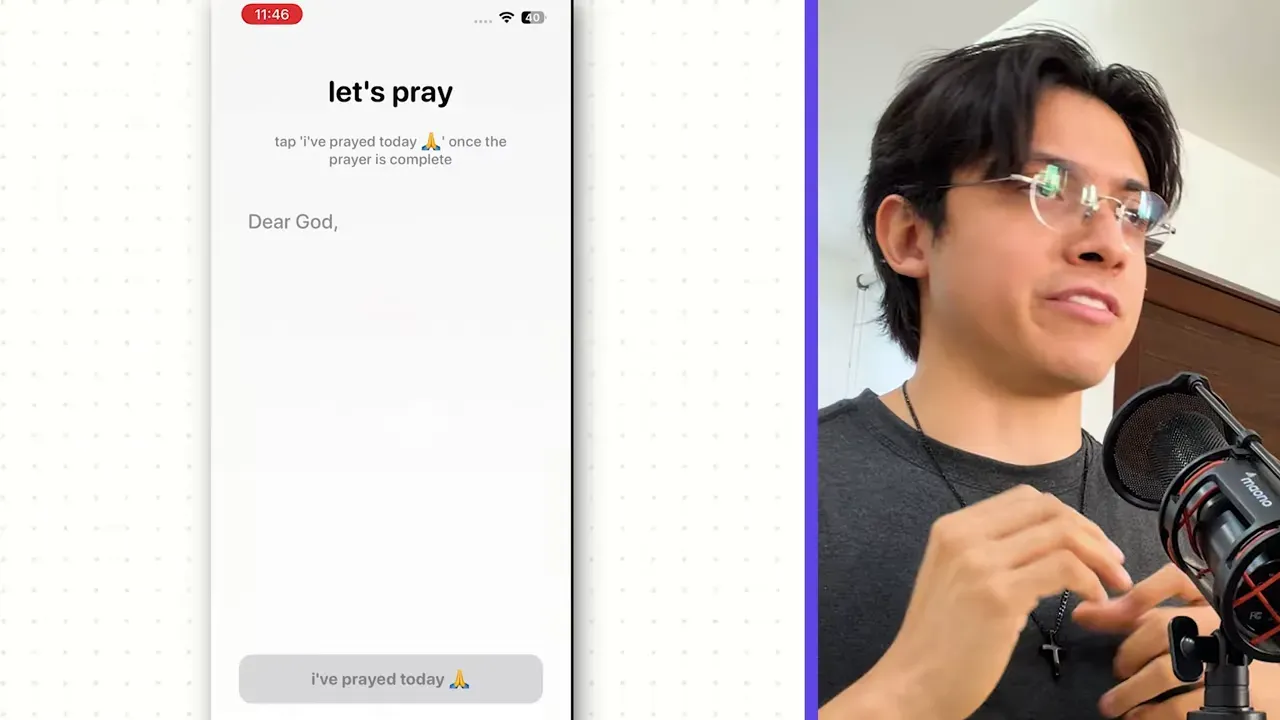
The flow is intentionally simple: the user selects which apps to block, then when they attempt to open a blocked app they are redirected to Prayer Lock. The app asks two quick state questions — relationship with God and emotional state — and generates a short, tailored prayer. Once the user recites the prayer and taps I’ve prayed today, the apps unlock for a chosen period and the user gets a daily verse and streak tracking.
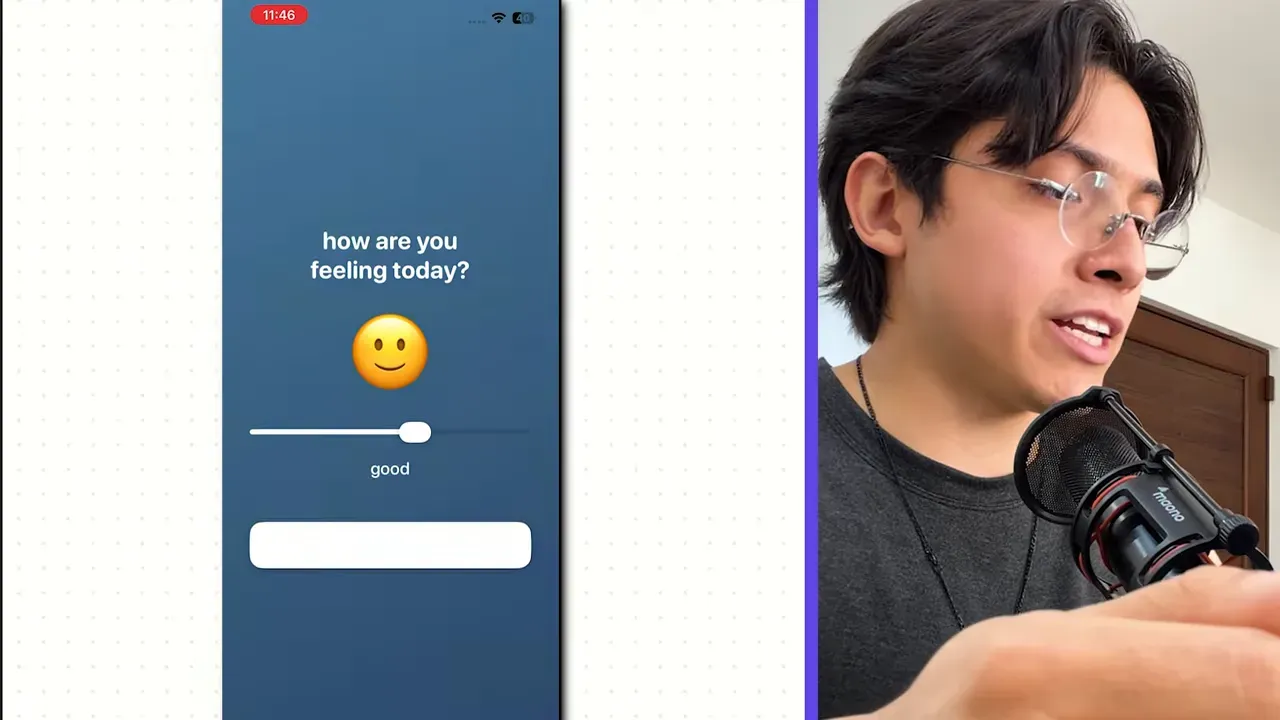
Simplicity reduces cognitive load and friction. Mao credits this simplicity for the surprisingly high onboarding and review rates.
⚖️ Reality check: what worked and what was risky
What would Mao tell his past self?
Mao regrets years lost on vanity ideas that had no market. His advice is blunt and practical: don’t build what you dream of first. Improve something that already works, learn distribution, and avoid feature creep. Only then attempt a more ambitious original idea.
🔁 Bringing it back to the primary tactic: AI-powered launch system for creators 🚀
Roger’s take: this case is a tidy checklist for an AI-powered launch system for creators. It pairs rapid AI-assisted development with lean product choices and a distribution-first mindset. The formula is repeatable: find a proven app, ship a simplified clone quickly, validate with organic UGC, then scale with paid Spark Ads running proven organic creative.
📚 FAQ — quick answers for the impatient
How long did it take to build the app?
Mao coded the initial MVP in about three days and got App Store approval within a week. The key was AI-assisted development and copying proven onboarding patterns rather than designing from scratch.
What is the pricing model?
Subscription: $49.99 per year or $9.99 per week.
Which ad channel produced the best ROI?
TikTok Spark Ads using high-performing UGC reaction videos provided the lowest cost per trial and the best scaling path.
Do you need a backend or authentication to make money?
Not necessarily. Mao intentionally avoided authentication and remote databases to reduce friction and costs. Local storage handled user state and the majority of users never ran into the edge case of switching phones.
What’s the minimum conversion target before scaling ads?
Aim for at least a 10 percent download-to-trial conversion rate before committing to significant paid spend.
🧾 Final verdict and next steps
Roger Mendoza’s read is pragmatic: the combination of AI tools, a narrowly focused product, and rigorous distribution is the low-variance path for a solo operator in 2026. The headline takeaway is straightforward: you can build something meaningful fast if you refuse to polish in private and instead iterate in public using real user feedback.
If a reader wants one practical experiment to run tonight:
- Pick a top app in a niche using Sensor Tower or App Store charts.
- Create a two-screen Canva mockup copying the best onboarding patterns you can find.
- Break the product into three blocks and prompt an AI assistant for each block’s code.
- Record one UGC reaction demo of the core feature and post it. If it gets 10K views organically, consider promoting it with Spark Ads.
Repeat the loop: ship, measure onboarding, refine, then scale. That is an AI-powered launch system for creators that actually pays attention to the only thing that matters — whether people are willing to pay.
This article was inspired by this amazing video I Grew My Mobile App to $20K/Month: Here’s My Entire Playbook. Check out more from their awesome channel.