
Breakdown: Miquel Palet, founder of Late — Zero to $40K/Month with One Marketing Channel
Miquel Palet grew Late, a developer-first social media API, to $40K MRR by going all-in on one channel: high-intent Google search, organic and paid. Here's the playbook.

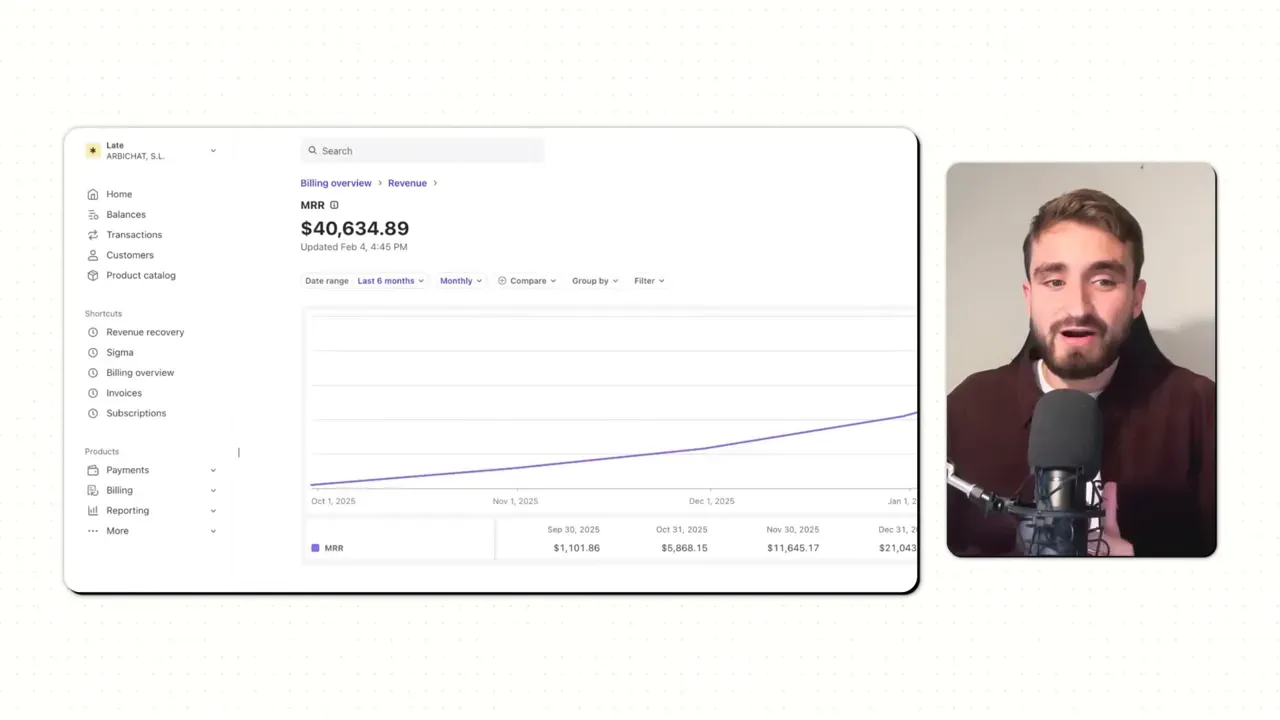
Table of Contents
- 🤖 Why this matters
- 🧰 Quick context: what Late is and what the numbers look like
- 🔎 The single-channel thesis: why pick one thing and obsess
- 📈 The actual playbook: organic and paid working together
- 💳 Growth with paid search: a disciplined approach
- 🛠️ The five-step Google playbook you can steal
- 🧪 Quick checklist before you bid on keywords
- 🔧 The product side: what Late actually looks like
- 🗣️ Real talk: what actually mattered and what didn't
- ⚖️ Costs, benchmarks and the conservative math
- 🧾 Closing advice: pick, obsess, measure (in that order)
- 🧰 Build This Stack
- ❓ FAQ
- 🚀 Final note
🤖 Why this matters
Most builders treat distribution like a buffet: try everything, get overwhelmed, leave hungry. Miquel did the opposite. He built Late, an API-first social media integration product, and leaned on one predictable channel: Google search — both organic and paid. This piece is for solo builders and small teams who want a repeatable playbook they can test tonight.
🧰 Quick context: what Late is and what the numbers look like
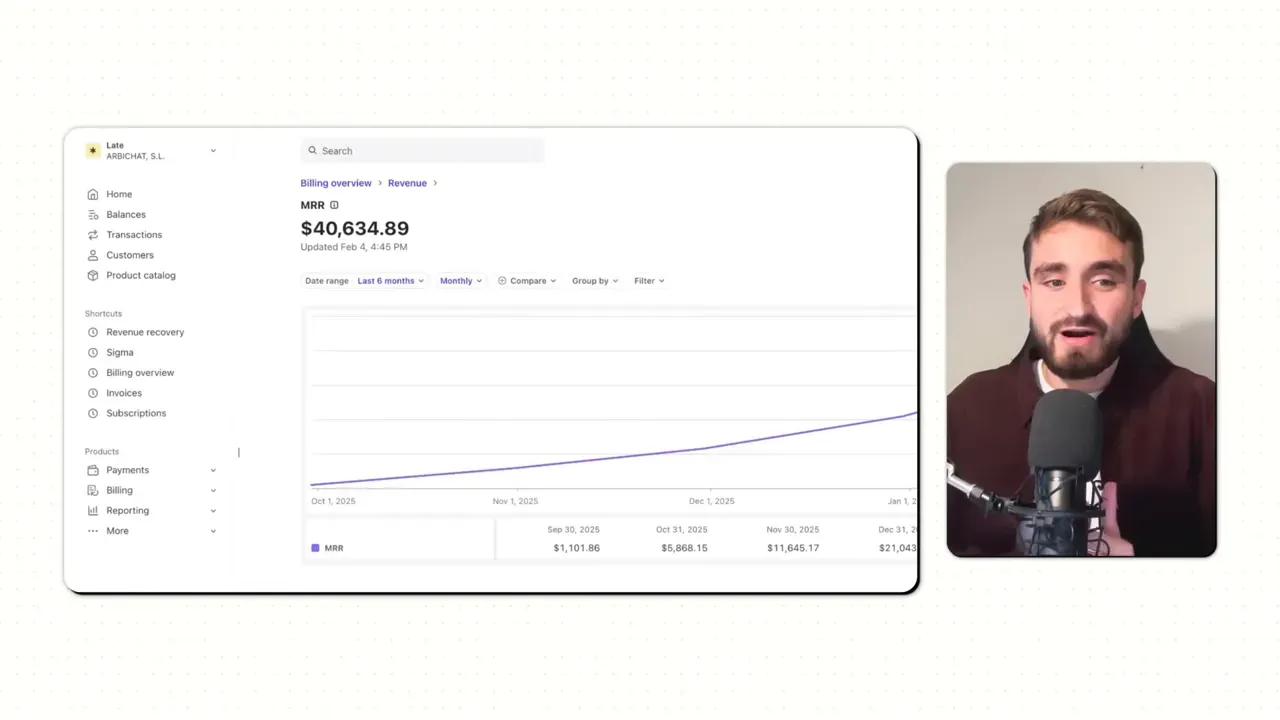
Late is a developer-focused wrapper around official social platform APIs. Instead of dealing with multiple platform permissions and plan differences, teams get a single consistent API with higher-tier capabilities under the hood. Pricing is account-based across three plans: Build, Accelerate, and Unlimited. Since launch, Late collected roughly 50,000 signups, crossed 700 paying customers, and reached over $40,000 monthly recurring revenue in under a year with churn under 10%.
How did you spot this gap in the market?
Miquel explains that after running an edtech startup and spending years building, he noticed social automation tools were either expensive, poorly documented, or overcomplicated. Developers hate bad docs. He built an API-first product focused on simplicity, then treated distribution as the problem worth solving next. The product shipped fairly lean; the growth engine carried the rest.
🔎 The single-channel thesis: why pick one thing and obsess
There are two tactics people confuse: creating demand and capturing demand. Viral content tries to create demand. Search captures it. When demand exists — people searching "social media API" or "Instagram scheduling API" — intent is high and economics are predictable. Miquel picked capture, not creation.
Why choose Google search over social or virality?
Search traffic converts because the user intent is explicit. Those searches show buying and implementation intent, not curiosity. Google gives fast feedback (paid) and compounding gains (SEO). For a B2B developer product, search is simply a more reliable channel than trends-driven social.
📈 The actual playbook: organic and paid working together
Miquel ran a tight two-part system: high-intent SEO that compounds over time and Google Ads that gives immediate predictable revenue. The trick is to use the same content and messaging across both. That makes testing faster and reduces waste.
What does the organic side look like?
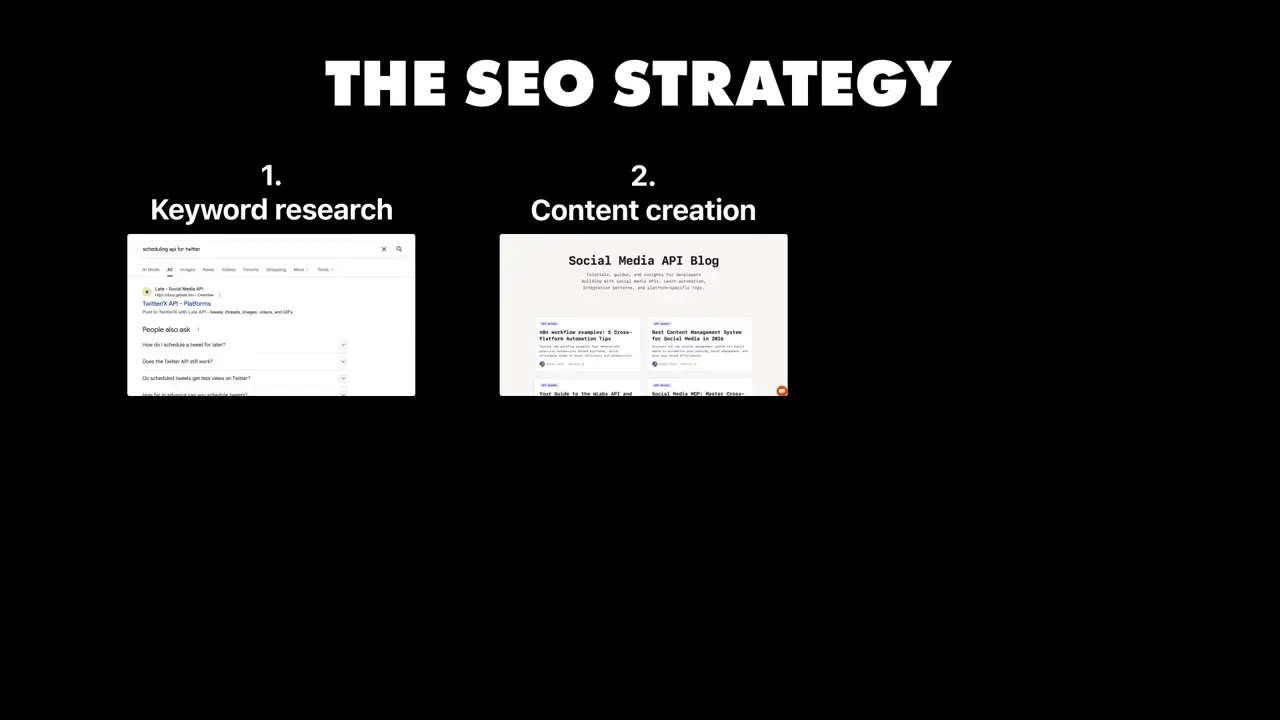
- Focus on bottom-of-funnel keywords that map directly to your product: think "social media API", "Twitter automation API", "Instagram scheduling API". - Use keyword tools (Ahrefs, Semrush) to find 300–800 monthly search volume terms with low difficulty. Those small-to-medium search volumes often mean clean intent and easier ranking. - Ship in-depth guides, landing pages or free tools that answer the buyer's question. Make pages fast, mobile-optimized, and structured so search engines and users both understand the value quickly. - Add internal links, track rankings in Ahrefs and Google Search Console, and invest in targeted backlink outreach when needed. Miquel even paid for high-value backlinks where ROI made sense.
How much did SEO deliver?
Organic moved the needle to roughly $8k MRR. That’s the compounding portion: you write once, and a handful of pages continue to bring customers month after month. But compounding is slow, so paid search filled the gap for scaling faster.
💳 Growth with paid search: a disciplined approach
Paid search was Late’s "guaranteed revenue engine." The team mirrored SEO keywords in paid campaigns, built tailored landing pages, and let Google’s bidding algorithm optimize for a target CPA. It’s not glamorous — it’s math.
How did paid search work in practice?
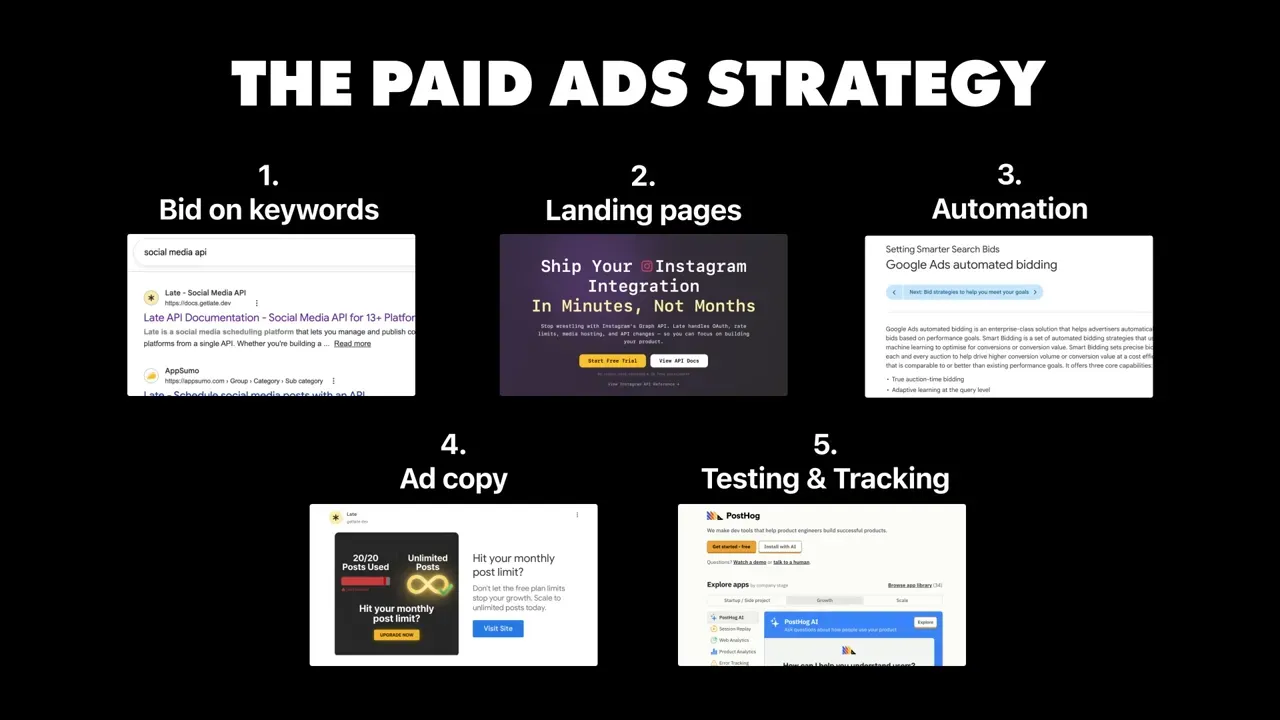
- Create ad groups that match each intent cluster. For every keyword like "Instagram API", there’s a specific landing page that answers that query. - Run three to five ad copy variations focused on value statements, not feature lists. Example headlines: "Scale 30 days of social in one hour" or "Build with a single social API". - Use automated bidding with a target CPA. Late set a $120 target CPA — a known threshold based on their average customer value — and let Google optimize toward it. - Track everything. They piped ad performance into Postgres and ran continuous A/B tests on headlines, descriptions and landing pages. - Scale spend month over month while the return on ad spend (ROAS) holds up. Miquel’s team spent about $8,000 per month on ads and got $2.50 in revenue for every dollar spent, generating roughly $15k MRR from paid.
🛠️ The five-step Google playbook you can steal
This is tactical. If you have an MVP and a few customers, you can run this tonight.
- Find core keywords — Build a spreadsheet of high-intent terms tied to your product. Include volume, difficulty, and a priority score. You already know some obvious ones; list those first. Target ranking in three to six months.
- Create high-quality content — Ship 10 to 15 well-crafted pages in week one. They could be landing pages, technical guides, or small free tools. Each page must have a clear CTA that feeds signups or trials.
- Launch correlated ads — Mirror your organic targets with paid ad groups. Use 3–5 ad copy variations focused on outcome, not features. Drive traffic to the matching landing page, not your home page.
- Measure and double down — Identify keywords that convert, increase their budgets, and cut the losers. Continuously A/B test copy, headlines and page layouts. Use the data to inform future organic content.
- Lower CAC relentlessly — Track CAC, LTV and ROAS in a dashboard. Aim for CAC under 30% of first-year revenue and closer to 24% of lifetime value as a long-term target. Optimize landing pages, sign-up flows and onboarding to improve conversion rate before throwing more ad spend at the problem.
🧪 Quick checklist before you bid on keywords
- Landing page fully aligned to search intent
- Analytics and conversion tracking installed
- Onboarding and product experience able to convert paid traffic
- Known CPA and LTV estimates to set smart bid targets
How many pages should I write?
Quality over quantity. Aim for 10 to 15 strong pages to start. Google doesn't reward noise. Those initial pages give signals to both organic and paid experiments — you can iterate from real conversion data.
🔧 The product side: what Late actually looks like
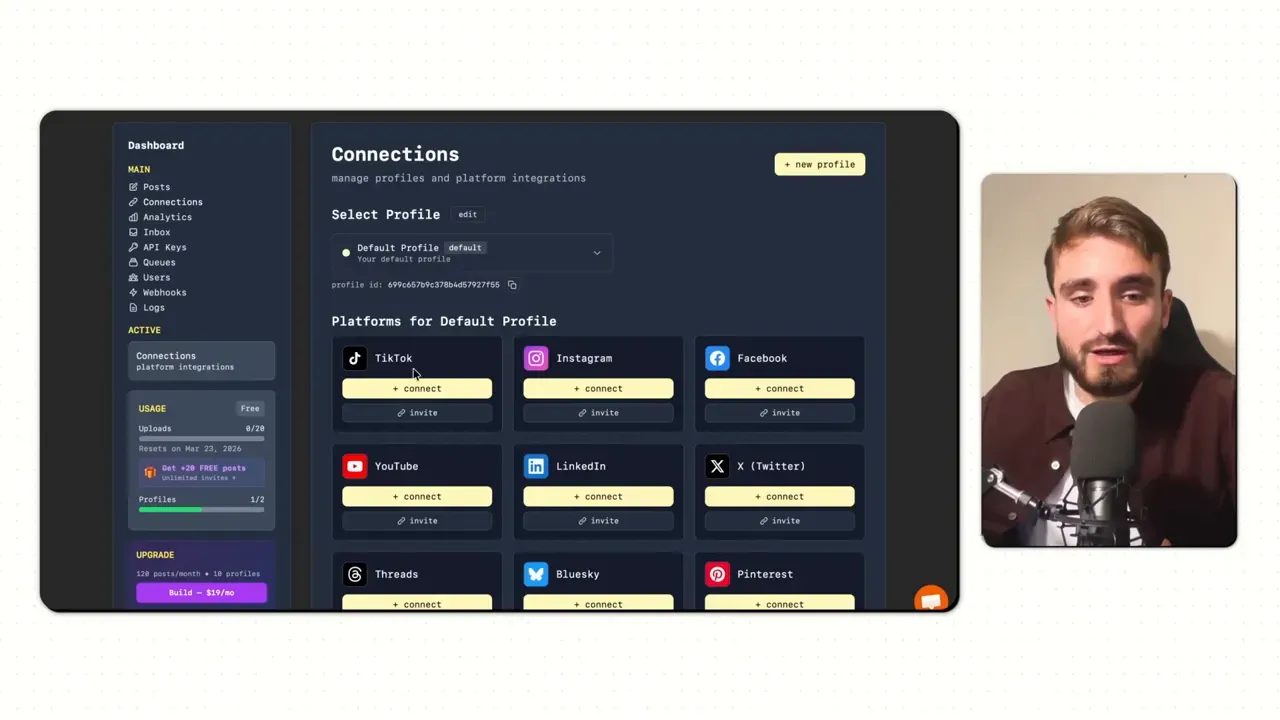
Late pairs a simple UI with a robust API. Everything you can do via the API is also available in the web scheduler: connect accounts, create posts, generate API keys, set webhooks, and read logs. Crucially, the docs are intentionally clear because the customer base is developers who need to integrate quickly.
What tech and tools power this growth stack?
- Core development runs on a cloud-based coding setup for speed. - Revenue attribution through DataFast, so revenue maps back to each source. - Ahrefs for keyword research and tracking. - Google Ads for paid acquisition. - Postgres used to centralize test and ad data. Monthly tooling spend mentioned: about $200 for Ahrefs plus the Google Ads budget (~$8k/mo).
🗣️ Real talk: what actually mattered and what didn't
The most actionable insight is not a growth hack. It’s this: pick one channel, get obsessively good at it, and measure everything. Miquel could have spread himself thin across social, communities, and PR. Instead, he chose a predictable, repeatable channel where unit economics could be modeled.
Would this work for non-B2B products?
Intent-based channels are strongest for products people actively search to buy or implement. B2B SaaS, dev tools, and niche services map well. Consumer products with impulse purchase patterns may need different acquisition mixes, but the principle of pick-one-channel still applies.
⚖️ Costs, benchmarks and the conservative math
Miquel used automated bids with a target CPA of $120 and tracked ROAS. At $8k monthly ad spend yielding $15k MRR from paid, the ROI sits at $2.50 per ad dollar. Organic added over $8k MRR. These numbers are real, not aspirational, and they show how paid and organic can complement each other to hit fast revenue targets.
What KPI targets should you set?
- CAC: Keep it under 30% of first-year revenue, aim for ~24% of LTV as a healthier target. - ROAS: Anything above 2x early is promising for scaling if margins permit. - Organic MRR: Track pages by MRR contribution, not visits. If a page brings $1,000+/mo, it’s a keeper.
🧾 Closing advice: pick, obsess, measure (in that order)
The big idea is boring: fewer things, done really well. For builders who prefer spreadsheets and funnels over on-camera content, this is a living, breathing alternative to the content hustle. Pair it with an AI-powered launch system for creators to automate content spin-offs, landing page variants, and initial ad copy generation — but don’t confuse automation for strategy.
If you had to give one piece of advice to your younger self, what would it be?
Stop being everything to everyone. Choose a single growth lever and grind measurement and iteration into a machine. That focus is what turns an MVP into a $40k/month business in months, not years.
🧰 Build This Stack
- Ahrefs for keyword research and rank tracking — Miquel's pick, at roughly $200/month
- Google Ads for paid search with a target CPA — the channel behind Late's ~$15K MRR from paid
- DataFast for revenue attribution — what Late used to tie revenue back to each channel
- Framer for one landing page per keyword cluster — a solid alternative if you'd rather not hand-build every page
- Make.com to pipe ad and signup data into one database — a solid alternative to custom scripts (Late used Postgres)
Some tools above may be affiliate links — we only list tools that fit the build.
❓ FAQ
Can I build the same growth engine without paying for backlinks?
Yes. Backlinks help but are not always necessary for bottom-of-funnel terms with clear intent. Prioritize on-page relevance, crisp metadata, load speed and a solid conversion path. If a specific backlink opportunity meaningfully shortens the path to rank for a high-value keyword, consider it as a paid acquisition decision.
How do I pick which keywords to bid on first?
Start with terms closest to your product and pricing. Volume matters less than intent. Use tools to filter for low difficulty and proven commercial intent. Bid on those you also plan to own organically — the combined data will inform which pages to double down on.
Is Google search dead because of AI and chat interfaces?
Informational search has shifted, but intent-based queries — the ones that lead to purchases or integrations — remain reliable. People still need tools. AI supplements discovery, but it does not eliminate the need to evaluate, trial and subscribe to software.
What’s the minimum monthly ad budget to test this approach?
You can begin meaningful tests with a few hundred to a couple thousand dollars if your CPA is low. For B2B tools with higher CPAs, plan at least $2k–4k to get signal. Miquel ran $8k/month when scaling, which gave clear conversion signals and enough data to optimize aggressively.
Which secondary tools are essential for this stack?
At minimum: an analytics platform, a keyword research tool (Ahrefs or Semrush), Google Ads, and a simple DB or spreadsheet to consolidate results. If you automate content generation with AI, keep editorial control — don't publish without human review.
What tools do you need to build a developer API SaaS like Late?
The core of Late's growth stack is a keyword tool like Ahrefs, Google Ads running on a target CPA, and attribution such as DataFast so every dollar maps to a page or campaign. For the pages themselves, Framer is a solid alternative to hand-building, and Make.com can move ad and signup data into one place without custom scripts.
🚀 Final note
This breakdown is a compact blueprint: find high-intent keywords, build pages that convert, use paid search to accelerate and fund organic growth, and obsess over metrics that matter. For anyone assembling a solo builder tech stack, this process scales cleanly — because it’s not magic, it’s math plus discipline.
This article was inspired by this amazing video Zero to $40K/Month With One Marketing Channel (No Social Media). Check out more from their awesome channel.