Breakdown: The Maker of HabitKit, the Indie Developer Using a Genius App Store Keyword Trick
HabitKit's maker put the search term before the brand: “HabitTracker-HabitKit.” Here's why that unglamorous naming move works so well for indie apps.

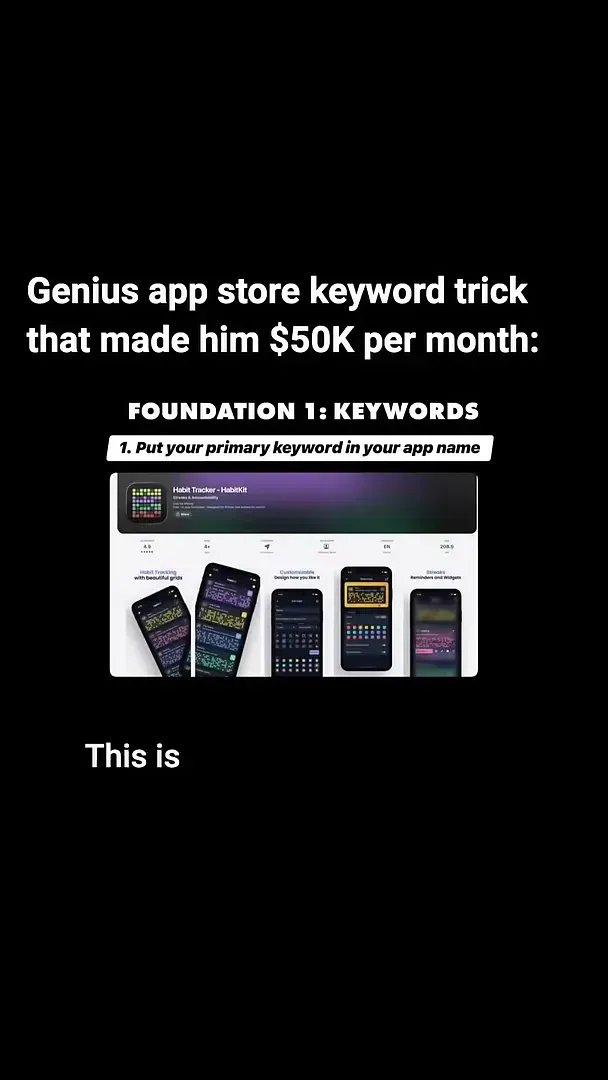
Table of Contents
- 😵 Why This Even Matters
- 🧰 The Setup
- 🔍 The Breakdown
- ⚙️ The Magic, Such As It Is
- 🧠 What This Gets Right About Search
- 🪓 The Real Talk on Branding
- 🛠️ A Small Blueprint Solo Builders Can Test Tonight
- 📉 What Not to Do
- 🧪 Would This Still Be the Move Today?
- 📌 The Takeaway
- 🧰 Build This Stack
- ❓FAQ
😵 Why This Even Matters
If an indie app gets discovered at all, it usually is not because the universe finally decided to be fair.
It is because someone made a very practical decision that felt a little unglamorous, a little annoying, and very effective.
That is the whole appeal here. No vague growth hacks. No chest-thumping about brand. Just one sharp app store move that helped drive serious revenue, with most user acquisition coming from a single channel.
For solo builders, this is the kind of thing worth paying attention to. Not because it is flashy, but because it works. The broader lesson applies to almost any launch, especially when distribution matters more than polish in the early days. If nobody can find the thing, the thing does not matter.
So this breakdown focuses on one deceptively simple question: what should an indie developer name their app if they want organic app store growth?
🧰 The Setup
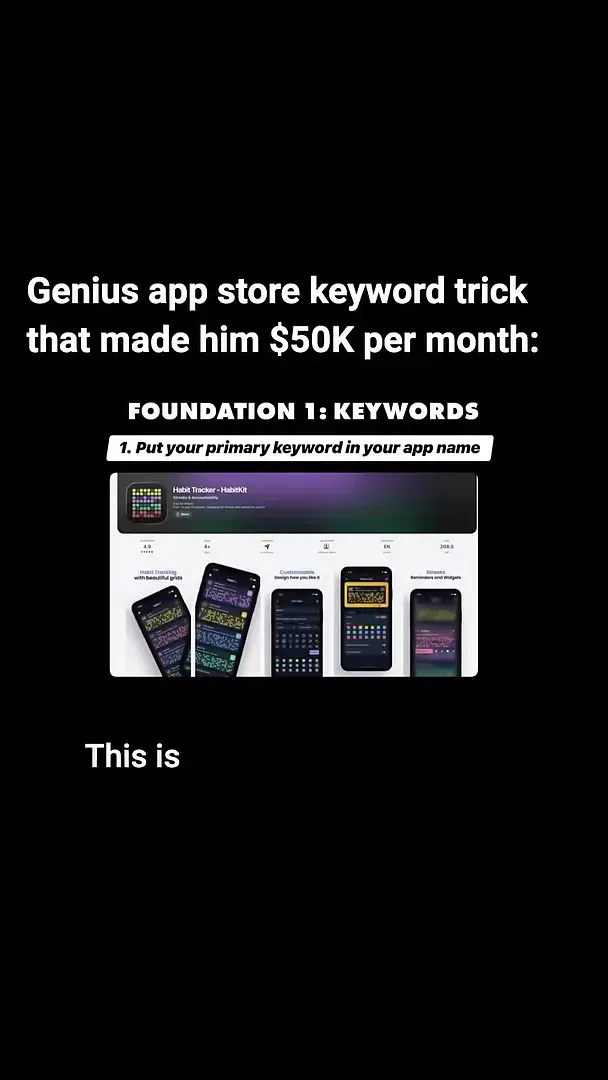
The product in question is HabitKit, a habit tracking app. But on the store, the name is not just HabitKit.
It is HabitTracker-HabitKit.
That naming choice is the strategy.
The logic is straightforward:
- HabitKit is the brand name.
- Habit tracker is the keyword people actually search for.
- The keyword is more valuable than the brand, especially early on.
Big companies can lean on recognition. Indie developers usually cannot. That means the title has to do more work.
🔍 The Breakdown
What is the single most important app store optimization rule here?
The answer is blunt: put the primary keyword in the app name.
Not buried in the subtitle. Not tucked into a description no one reads. Not saved for later because it makes the branding team feel weird, which is especially funny when the branding team is just one tired person with Figma open at midnight.
The app name matters because it carries weight in app store discovery. If the main thing people search is not in the title, an indie developer is making the job harder than it needs to be.
That is the core trick. Simple enough to sound obvious, powerful enough that many people still avoid doing it.
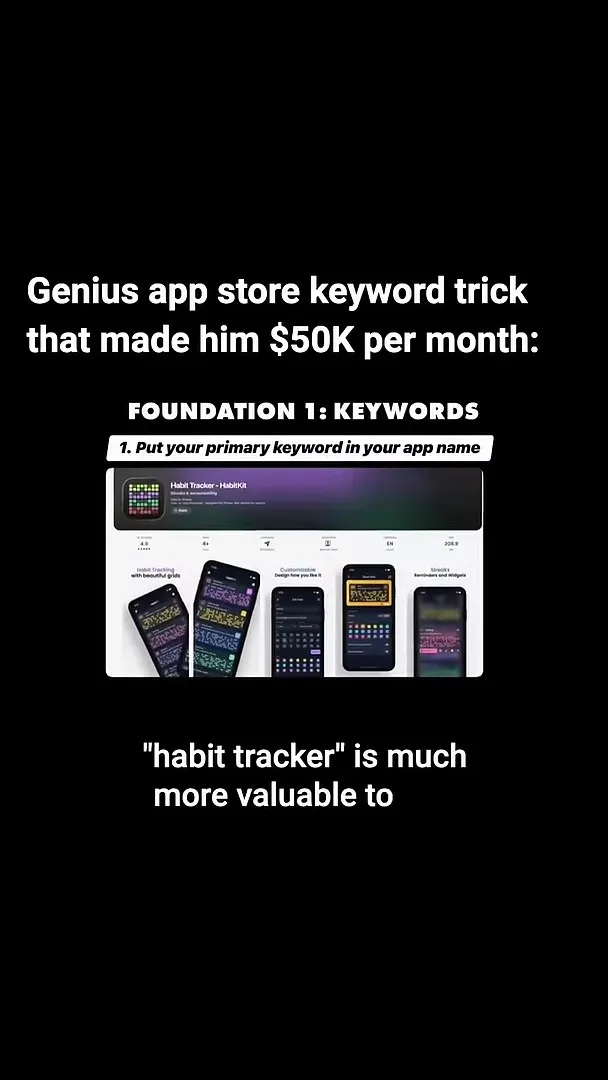
Why is HabitKit named “HabitTracker-HabitKit” instead of just “HabitKit”?
Because “habit tracker” has more search value than “HabitKit”.
That is the trade-off. Brand purity loses to discoverability when nobody knows the brand yet.
For an established company, the app name itself may already be a search term. For an indie product, the product name often means nothing to the market at the start. Search intent lives in generic terms. People open the app store and type what they want, not the app they have never heard of.
They search for:
- habit tracker
- budget planner
- running app
- to-do list
They do not search for your clever invented word unless your app has already won.
That is why the title was structured to capture both:
- the category keyword first
- the brand name second
It is not glamorous. It is useful. Those are often in conflict.
Why put the keyword first instead of second?
Because placement signals priority.
The main keyword should lead because it is doing the heavy lifting. The title needs to align with the exact phrase that matters most for discovery.
That is why “HabitTracker-HabitKit” makes more sense for an indie app than “HabitKit Habit Tracker,” and definitely more sense than “HabitKit” alone if growth depends on search.
The principle is not just that the keyword appears. It is that the keyword is treated as the main job of the title.
If organic app store traffic is the engine, then the title is not just a label. It is distribution infrastructure.
What can indie developers learn from this that bigger companies can ignore?
Big brands get away with things because they are big brands. That is the annoying truth.
A company like Duolingo can put the keyword second and still win because people already know Duolingo. The brand itself has become searchable. It has momentum, trust, press, backlinks, word-of-mouth, and the unfair advantages that show up after years of being very visible.
An indie developer usually has none of that.
Which means indie builders should not copy the naming style of giant apps unless they also plan to copy the giant marketing budget, giant user base, and giant pile of brand equity. Most cannot. So the smarter move is to optimize for search first.
This is one of those areas where trying to look polished like a large company can quietly sabotage growth.
So should every indie app title start with a keyword?
Based on this approach, yes, if search discovery is important and the primary keyword is clear.
The practical framework looks like this:
- Find the main thing users search for
- Put that keyword in the app name
- Keep the brand name in the title too
- Prioritize discoverability over elegance
That does not mean stuffing in nonsense or turning the app title into a coupon flyer. It means making sure the most valuable search phrase is impossible to miss.
For anyone piecing together a solo builder tech stack, this same mindset applies across the board: use the plain words people search for before worrying about whether the naming feels premium.
⚙️ The Magic, Such As It Is
This is not a complicated system. Which is good, because most complicated systems are just expensive ways to avoid making a decision.
The real move here is a compact app store optimization play:
Step 1: Choose the primary keyword with commercial value
In this case, the valuable phrase was habit tracker.
Not because it sounds nice, but because it matches user intent.
Step 2: Put that keyword directly in the app name
Not hidden elsewhere. In the title itself.
Step 3: Attach the brand name after it
This preserves identity while still letting search do the heavy lifting.
Step 4: Accept that discoverability beats aesthetic perfection
A neat brand-only title may feel cleaner. It may also be invisible.
That is the full move. Very little ceremony. Very high leverage.
🧠 What This Gets Right About Search
The strategy works because it respects how users behave.
Most people do not browse the app store like they are strolling through a boutique. They search with intent. They already know the problem they want solved. The query often looks exactly like the category.
That means app naming is not only about identity. It is also about matching demand language.
In plain terms:
- If someone wants a habit tracker, the phrase habit tracker is what matters.
- If the app title reflects that phrase, it becomes easier to surface.
- If the title is only a brand name, the app may rely too heavily on outside traffic or word-of-mouth.
This is why the same thinking shows up in other practical build systems too. Whether someone is writing a landing page, naming a feature, or stitching together a lightweight distribution engine, language that matches search intent almost always beats language that only sounds clever in a pitch deck.
Is this just keyword stuffing?
No. There is a difference between precision and spam.
Keyword stuffing is when everything becomes unreadable sludge. Precision is when the title clearly says what the app is, using the term people already use.
“HabitTracker-HabitKit” is not random stuffing. It is a category term plus a brand term. Clear, intentional, functional.
🪓 The Real Talk on Branding
There is a familiar fear underneath all of this: if the app title leans too hard into a keyword, will the brand feel weaker?
Maybe, a little, in the short term.
But obscurity is usually worse than slight inelegance.
Brand becomes more meaningful after discovery starts happening. Before that, the keyword often carries more value. That is especially true when a product depends on app store search for the majority of its user acquisition.
The trade-off is not really:
- beautiful branding versus ugly branding
It is more often:
- discoverable product versus invisible product
And invisible products, while technically elegant, have a way of not paying rent.
What is the deeper lesson for solo builders?
Do not optimize for how successful companies present themselves now. Optimize for what gives an unknown product a real chance to get found.
That means being a little less romantic about naming and a little more clinical about intent.
People who build alone or in tiny teams do not get many free shots. So the right move is usually the one that compounds distribution.
🛠️ A Small Blueprint Solo Builders Can Test Tonight
For anyone shipping an app and trying to avoid wasting months on avoidable mistakes, the process can be boiled down to this:
- Write down the one search phrase your ideal user would type first.
- Ask whether that phrase is in the app title.
- If it is not, decide whether brand vanity is getting in the way.
- Rework the title so the keyword appears clearly and prominently.
- Keep the brand name attached so long-term identity still builds.
This is not an entire launch plan, but it fits the same philosophy. Strip away the fluff. Make the key discovery mechanism obvious. Build from there.
If someone is already experimenting with automation or trying to improve conversion after discovery, that is great. But first the app needs to be found. Search visibility comes before funnel optimization.
📉 What Not to Do
A few mistakes are implied by this strategy, and they are worth spelling out.
Do not lead with a brand nobody knows
If the title starts with an invented name and leaves out the main keyword, the app may miss the exact search behavior that matters most.
Do not copy enterprise naming patterns blindly
Large brands can put search terms second because they have already earned attention. Most indie products have not.
Do not confuse neatness with effectiveness
A cleaner title is not automatically a better title. The better title is the one that improves discovery.
🧪 Would This Still Be the Move Today?
Based on the principle alone, yes.
If the product depends heavily on app store search, the title should reflect the highest-value keyword. The exact formatting may vary by platform rules and listing constraints, but the strategic point holds up cleanly:
an indie app should not waste the title field on branding alone if search is a major acquisition channel.
It is one of those decisions that looks almost too simple. Then it drives results, and suddenly everyone acts like they knew all along.
📌 The Takeaway
The “genius app store keyword trick” is not really genius in the theatrical sense. It is genius in the far more useful sense: it is practical, obvious in retrospect, and tied directly to how people actually discover apps.
The maker of HabitKit used the app title strategically by naming it HabitTracker-HabitKit, because habit tracker mattered more for search than the brand name alone.
That is the lesson.
If a builder is unknown, the title should help users find the product before it tries to impress them. Big brands can afford to be subtle. Indies usually cannot.
And honestly, that is a useful rule far beyond app stores. Any launch lives or dies on discoverability first. Fancy comes later. Found comes first.
🧰 Build This Stack
The video only covers naming, so nothing below comes from HabitKit's maker. These are solid picks for building and launching a similar indie app:
- Framer for your app landing page — a solid alternative for a simple site that repeats the same search phrase as your store title.
- Lovable as an AI app builder — a solid alternative if you want a working prototype of a tracker app before committing to a full build.
- RevenueCat or Superwall for subscriptions and paywalls — solid options once search traffic starts turning into users.
Some tools above may be affiliate links — we only list tools that fit the build.
❓FAQ
What is the main app store keyword strategy used here?
The strategy is to place the primary keyword directly in the app name. In this case, the valuable keyword is “habit tracker,” so it appears before the brand name.
Why is “HabitTracker-HabitKit” better than just “HabitKit” for growth?
Because “habit tracker” is a phrase people are likely to search for in the app store, while “HabitKit” only helps if people already know the brand.
Should indie developers prioritize keywords over branding in app names?
If app store search is a major source of user acquisition, yes. The title should help people discover the app first. The brand can still be included, but the keyword should do the initial work.
Why can larger apps like Duolingo afford to put keywords second?
Because they already have strong brand recognition. People search for the brand itself, so they do not rely as heavily on category keywords in the title.
Is this approach relevant beyond app stores?
Yes. The broader principle is to use the language your audience already searches for. That applies to product naming, landing pages, SEO, and lightweight growth systems.
What tools do you need to build a habit tracker app like HabitKit?
Fewer than you might think: a way to build the app, a subscription layer such as RevenueCat or Superwall, and a simple landing page that uses the same search phrase as your store listing. The bigger lever is the listing itself — put the primary keyword, like “habit tracker,” in the app name before the brand.
This article was inspired by this amazing video Genius app store keyword trick that made him $50K per month. Check out more from their awesome channel.