
This App Makes $35K/Month With One Influencer: Breakdown of Flo (MonAI) and His Creator Launch System
MonAI sat at a few hundred dollars a month for over a year. One aligned influencer, a profit-based deal and story-driven videos took it past $35K MRR.

Right now, it’s easier than ever to build apps. The annoying part is distribution. TikTok. Paid ads. Reddit. Repeat. Most solo builders end up doing “a little bit of everything,” which is a cute way of saying “nothing long enough to compound.”
Flo (MonAI) hit the classic wall: a few hundred dollars per month for over a year, despite iterating and shipping. Then one partnership changed the trajectory fast. The interesting part is that the outcome wasn’t about building some new category. It was about fixing the one thing that actually matters: getting people to see the product and care enough to pay.
This is a conversation-style case study on an AI-powered launch system for creators using an influencer partnership with built-in incentives, plus a product that makes adoption frictionless using AI, voice, and automations.
Table of Contents
- 🎯 Why Distribution Hurts More Than Building
- 🧾 The App: MonAI (Expense Tracking That Feels Effortless)
- 👤 Flo’s Background: Why He Could Build This Solo
- 💡 How the Idea Happened (Personal Pain, Then AI)
- 🚦 The Moment Everything Changed: One Influencer Partnership
- 🧠 The Partnership Setup: Trust + Contract + Profit Share
- 📈 Video Examples and Measured Impact (Not Just Vibes)
- 🧩 The Influencer Marketing Playbook (If You’re Starting From Scratch)
- 🧪 A Quick Demo of MonAI’s AI Features (What Users Actually Do)
- 🧰 Tech Stack (The Lean Setup You Can Borrow)
- 💸 Final Advice: Use Content to Unlock Ads (Don’t Burn Money Blind)
- 🤝 The Skeptical Reality Check (Why This Strategy Still Isn’t Magic)
- 🧰 Build This Stack
- ❓ FAQ
- 🧱 A Test Plan You Can Run This Week (Without Waiting for “Perfect Marketing”)
🎯 Why Distribution Hurts More Than Building
Flo’s story starts like a lot of ours: building is the fun part. Distribution is the hard part. And when you are stuck at low revenue, it’s easy to blame the product.
That’s the trap. Flo’s realization was blunt: the product wasn’t the problem. Nobody was seeing it.
Key takeaway: If you are not getting consistent acquisition, “product market fit” is often just “distribution market fit.” Solve visibility first, then refine the details.
🧾 The App: MonAI (Expense Tracking That Feels Effortless)
Flo built an expense tracking app called MonAI. It aims to remove the friction of logging expenses. Instead of making people type categories and amounts like it’s 2013, MonAI uses AI to make it feel more natural.
Core idea:
- Voice input to create transactions.
- Automations and integrations to reduce manual work.
- Minimal UI and no bloat. The app focuses on what matters: where money goes.
Flo also described how the app works in practice:
- Add an expense manually, or speak it like: “coffee at Starbucks, 50 bucks,” and the app turns it into a transaction.
- It can automatically add tags and categories.
- It uses Apple Pay automation and shortcuts integrations to make the “capture” moment easier.
- It includes AI reporting where users can ask questions about their finances, like where they should cut costs to save a specific monthly amount.
And yes, this is still expense tracking. The “not unique” part is true. But the “frictionless experience + distribution engine” part is where the business gets real.
MonAI revenue snapshot
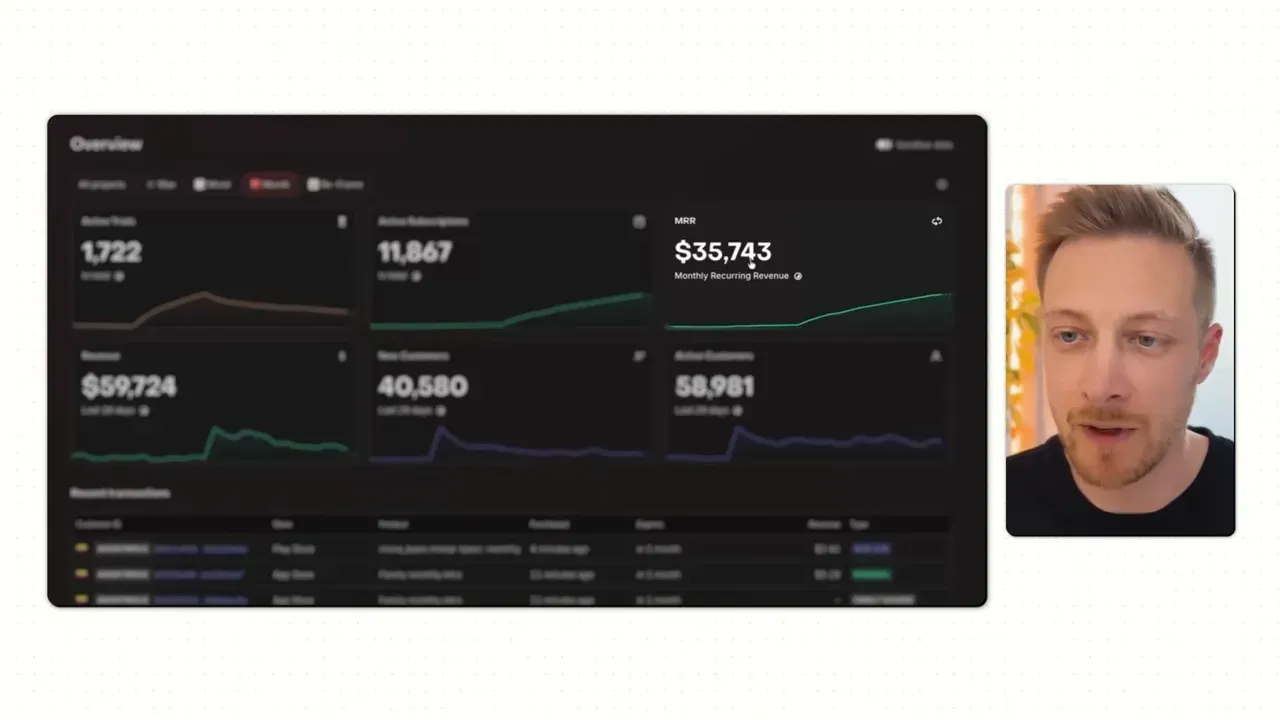
Flo reported it is currently around 35K MRR and uses a subscription model with:
- Seven-day trial (instead of freemium).
- Previously experimented with freemium and AB testing, then switched to a hard paywall with a free trial because it worked better.
👤 Flo’s Background: Why He Could Build This Solo
Flo is from Germany. He studied computer science after initially being interested in the creative space. He taught himself to code iOS apps, then worked as a mobile UX lead.
He kept building side projects, but none clicked until MonAI. Eventually, he could quit his job and build full-time.
What matters here for solo builders isn’t his career path. It’s the pattern:
- He didn’t start with a massive growth plan.
- He kept shipping until one product finally fit a real use case.
- Once the product existed, growth became the next job.
💡 How the Idea Happened (Personal Pain, Then AI)
Flo’s idea for MonAI came from personal use. He wanted to track his expenses but kept quitting other apps because they were too cumbersome.
Then AI got “fairly usable,” and he started combining two things:
- Expense tracking (a real, persistent need)
- AI to make entry frictionless (voice + automation)
Another detail that shouldn’t be ignored: he cared about speed to market. He built the first version in a month or two, then iterated continuously.
Reality check: If you are waiting for perfection, you are just volunteering to be invisible longer than necessary.
🚦 The Moment Everything Changed: One Influencer Partnership
Flo went from about $300 MRR after 1.5 years to over 35K MRR in just over a year. The difference was distribution, specifically a partnership with one influencer.
The influencer partnership wasn’t one of those “pitch 20 creators and pray” strategies. In Flo’s case, it worked like this:
- After negotiating some early terms, the influencer reached out because he found Flo’s app socials inside the app itself.
- They came to an agreement.
- The influencer started posting three videos per month on his main channel.
Impact timing Flo shared:
- In the first week after the first video (late 2024), MRR 10xed.
- Within a month, MRR was near 8K.
It wasn’t “a million views.” It was a steady conversion path from an audience that matched the product’s vibe.
🧠 The Partnership Setup: Trust + Contract + Profit Share
Flo emphasized that the partnership is built largely on trust. There is a contract, but the commercial model matters too.
Previously, they tried a revenue share model. They found it didn’t scale well. Now it’s more aligned.
What worked:
- Profit-based percentage (not just revenue).
- Fixed monthly retainer.
This created incentives that did not depend on hope:
- The creator is incentivized to do what is best for the app.
- It’s not “employee behavior” where they post one video and move on.
- The influencer also helps with video ideas, acting as the creative driver.
And then there’s the “quality over quantity” decision that most people ignore:
- Only three videos per month.
- High quality, story driven.
- Designed to convert rather than chase vanity metrics.
Flo’s view is basically: if you dilute output, you dilute learning and creative effort. Better fewer assets that are genuinely good.
📈 Video Examples and Measured Impact (Not Just Vibes)
Flo built a small visualization tool to track the timing and impact of influencer videos on MRR. This is one of those “boring” moves that prevents you from gaslighting yourself.
Some of the milestones he described:
- The first simple walkthrough video plus another video helped push from about $300 to 7.8K MRR.
- Another boost (still short) increased MRR from roughly $8K up to 13K after that period.
- There was a low season until a June 21 moment when MonAI was invited to join Apple’s WWDC together, which became a strong story.
- That story-driven video totaled about 1.7 million views and grew MRR by about +5K.
- A latest feature release wanted by users, again packaged as a story, took MRR to over 35K.
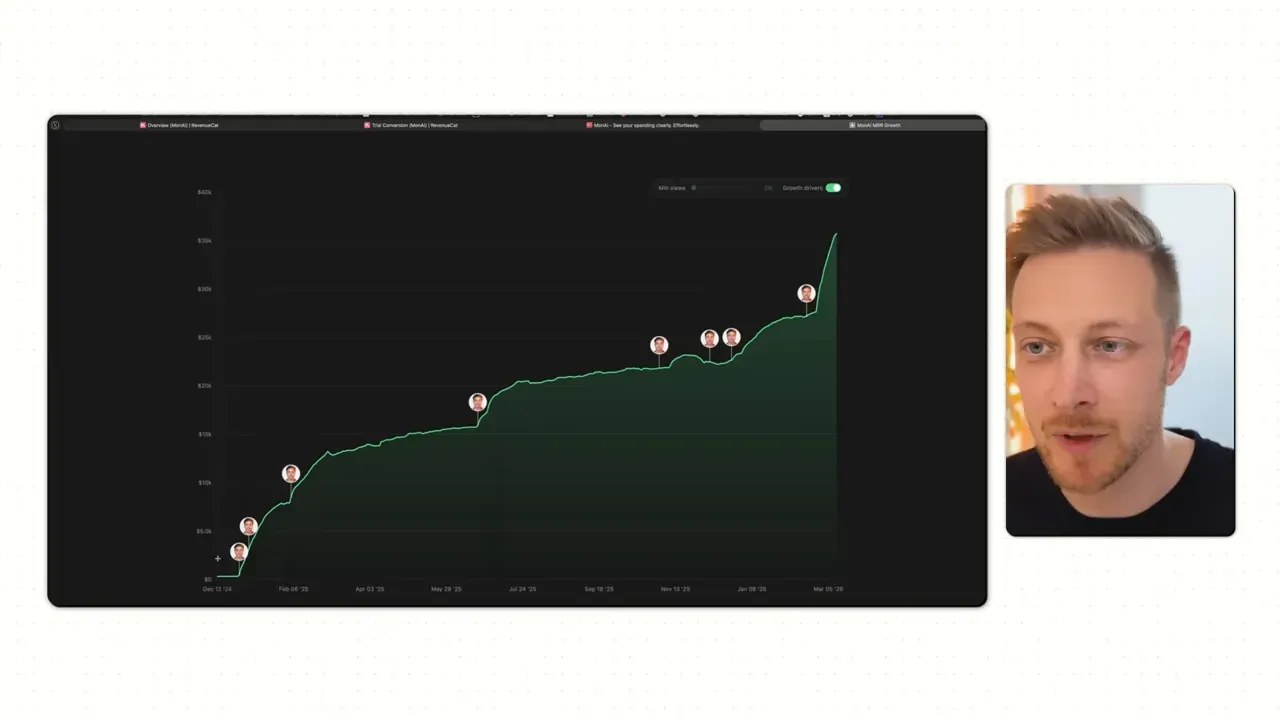
Important nuance: The videos didn’t just create awareness. They aligned with user intent. Story driven content matched a product that is minimal, aesthetic, and tech-enabled with AI automation.
🧩 The Influencer Marketing Playbook (If You’re Starting From Scratch)
Flo gave a practical playbook for influencer partnerships. This is the part you can use tonight, even if you do not have a creator already lined up.
Step 1: Find aligned partners
Don’t chase “big audience.” Chase fit.
- Check the influencer’s tone and lifestyle match your product.
- Look for replies to comments. If people ask questions about the app, the creator responding matters.
- Prefer influencers who are not purely tech spec readers, but also tell stories. Flo described his target as “tech and lifestyle.”
Step 2: Warm up the relationship
Follow and engage before reaching out so it does not feel like a random transaction.
If you do not have time to warm up properly, be honest. Don’t fake it.
Step 3: Be specific with outreach
Generic messages get ignored. Instead:
- Reference a specific video or even a moment (a joke, a detail, a segment).
- Show you actually watch and care.
Step 4: Connect the dots to your product
This is about alignment, not persuasion.
- Explain why the creator’s audience values overlap with what your app delivers.
- Flo’s example: his product is minimalistic and aesthetic, but still tech heavy with AI automations.
Step 5: Acknowledge the value and signal willingness to pay early
This is where most outreach fails. People lead with “let’s collab” and hope the creator figures out incentives later.
Flo recommends:
- Make it clear they will be paid, one way or another.
- Show future upside using examples from the niche (Flo suggested looking up earning apps via tools like SensorTower).
- Include a mental model like: “Other apps in this niche make 50K to 100K per month with the right distribution.”
Bonus tips that reduce friction
- Be brief because creators get hundreds of emails.
- If possible, send a personalized video mentioning the creator’s name and their content.
- Add your social handles to your app profile so creators can find you. Flo felt this would matter more over time as app popularity increases.
- Look beyond the US. Flo’s influencer operated in Colombia, and that created a different runway for growth.
Solo builder translation: You are not hiring a marketer. You are partnering with a storyteller who has incentive and audience fit.
🧪 A Quick Demo of MonAI’s AI Features (What Users Actually Do)
Flo’s demo reinforced a simple point: AI is not the product. The product is convenience.
He walked through:
- A minimal interface without tabs.
- The expense list and a clear “add expense” flow.
- Voice input that turns speech into a categorized transaction.
- Shortcuts and Apple Pay automations that add transactions automatically once realized.
- AI reports that answer questions like how to cut costs to save a monthly target amount.
That combination is what made the influencer content convert. It gave the creator repeatable demonstration scenarios: voice entry, automation, and “ask your finances” reporting.
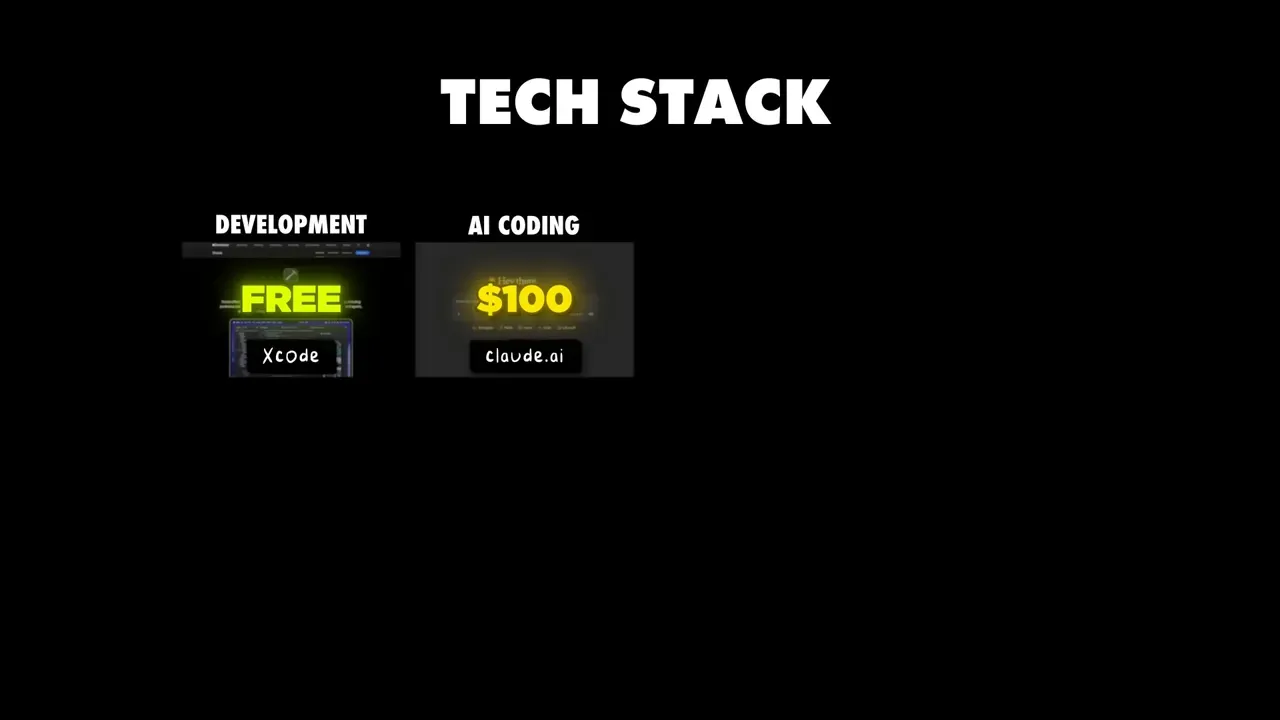
🧰 Tech Stack (The Lean Setup You Can Borrow)
Flo builds natively and kept tooling pragmatic. He shared the stack roughly like this:
- Xcode for iOS (free).
- Claude Code (Max plan, about $100/month).
- RevenueCat for revenue stats and AB testing.
- Appwrite for backend, auth, and database.
- AI stack splitting tasks:
- OpenAI for easier tasks.
- Anthropic for deeper analysis.
- Helm to reduce pain around App Store Connect (lifetime plan around $175).
- Figma for design (free plan).
Cost notes Flo shared included AI request costs and tool costs, with the reminder that the exact number will vary based on usage.
Builder takeaway: The stack is not the magic. Distribution and onboarding friction are the magic. The stack just has to be reliable enough to ship improvements fast.
💸 Final Advice: Use Content to Unlock Ads (Don’t Burn Money Blind)
Flo admitted he was reluctant to start with Meta ads because it looked intimidating. He feared wasting money.
Then he noticed something practical: the creator could make great videos, and those videos can be reused to experiment with Meta ads easily.
After starting a few weeks ago, he reported “really great results” already.
Reality check: Ads only work when the content is good. So do not start with “targeting.” Start with “assets,” then iterate on targeting.
🤝 The Skeptical Reality Check (Why This Strategy Still Isn’t Magic)
Starter Story producer Gus added perspective worth keeping:
- Many founders try influencer spamming. Flo’s approach was the opposite: one creator that had skin in the game.
- “One influencer that really crushed it” is usually the pattern, even when people contact many.
- It also matters that the influencer has incentives tied to profit, not just posting.
- Yes, it’s essentially another budget tracking app, but distribution makes the difference. Even if the category is crowded, the right audience can still convert.
So this is not permission to believe in influencer fairy dust. It’s permission to build a distribution system where incentives align and the assets convert.
🧰 Build This Stack
Want to build something similar? Here's a lean stack, one tool per job:
- Xcode + Claude Code for building natively — Flo's own setup
- RevenueCat for subscriptions, paywalls and A/B tests — what MonAI uses
- Appwrite for backend, auth and database — Flo's pick
- Framer for your app landing page — a solid alternative if you want a simple site that creators and their viewers can find
- ElevenLabs for AI voiceovers — a solid alternative for producing extra ad variations once you start reusing creator videos in Meta ads
Some tools above may be affiliate links — we only list tools that fit the build.
❓ FAQ
What made MonAI grow from a few hundred dollars to $35K+ MRR?
Flo attributed the jump primarily to distribution through a single aligned influencer partnership. The influencer posted three high-quality, story-driven videos per month, and the contract structure (profit-based incentives plus a retainer) kept the creator focused on what would work for the app.
Do you need a TikTok army or lots of influencers to make this work?
No. Flo’s results came from one influencer and a limited number of posts per month. The strategy favored quality and conversion over high volume and vanity metrics.
What should solo builders look for when choosing an influencer?
Look for audience and lifestyle alignment with your product, creator responsiveness (replies to comments), and storytelling fit. The influencer should not just be “tech focused,” but able to connect with viewers in a way that matches your app’s experience.
How should the influencer deal be structured?
Flo described using a combination of a fixed monthly retainer plus a profit-based percentage. They previously tried revenue share and found profit-based incentives scaled better because it tied payouts to what’s best for the app.
What is the launch system idea here?
The system is: build a product with AI that reduces user friction, then attach distribution to repeatable content assets from an aligned creator. Those content assets can later be reused for paid experiments like Meta ads.
What content types seemed to perform best for MonAI?
Flo emphasized story-driven videos, including walkthroughs, short feature demonstrations, and timely story hooks (like joining Apple’s WWDC). Videos did not need “millions” of views to convert, as long as they matched user intent and product value.
Can this work outside the US?
Flo specifically pointed out looking beyond US-only creators. His influencer partnership operated in Colombia, showing that emerging markets can offer strong growth opportunities when audience fit is right.
What tools do you need to build an AI expense tracker app like MonAI?
Flo built MonAI natively in Xcode with Claude Code, uses RevenueCat for subscriptions and A/B tests, Appwrite for backend and auth, OpenAI and Anthropic models for the AI features, and Figma for design. A landing page and a way to produce more ad variations are optional extras covered in the stack above.
🧱 A Test Plan You Can Run This Week (Without Waiting for “Perfect Marketing”)
If someone copied Flo’s approach but did it sloppily, it would still fail. This is the version that doesn’t require you to become an influencer manager overnight.
- Pick one aligned creator niche. Not “broad tech.” Find creators whose audience cares about the same outcome your app delivers.
- Create 3 story-ready demos. Voice capture, automation moment, and one AI report question. These are “video hooks” disguised as features.
- Outreach using specifics. Reference a particular video and moment. Keep it short.
- Signal incentives early. Mention profit share or another clear payment structure. Don’t imply the creator will do it “for exposure.”
- Warm up just enough. Follow and engage before outreach, or be honest if time is limited.
- After you land content assets, test ads later. Use the videos to experiment with Meta ads. Build assets first, then target.
That’s the launch system hiding in plain sight: a frictionless product that demonstrates well, plus a distribution partner who has incentive to do great work, not just output.
Real talk: If you don’t have distribution yet, stop obsessing over “more features.” Start building the pathway people use to find your app. Then ship the next improvement when you finally know what converts.
This article was inspired by this amazing video This App Makes $35K/Month With One Influencer. Check out more from their awesome channel.