
Interview with Nevo David, Founder of Postiz and Builder of an Agentic Social Media SaaS

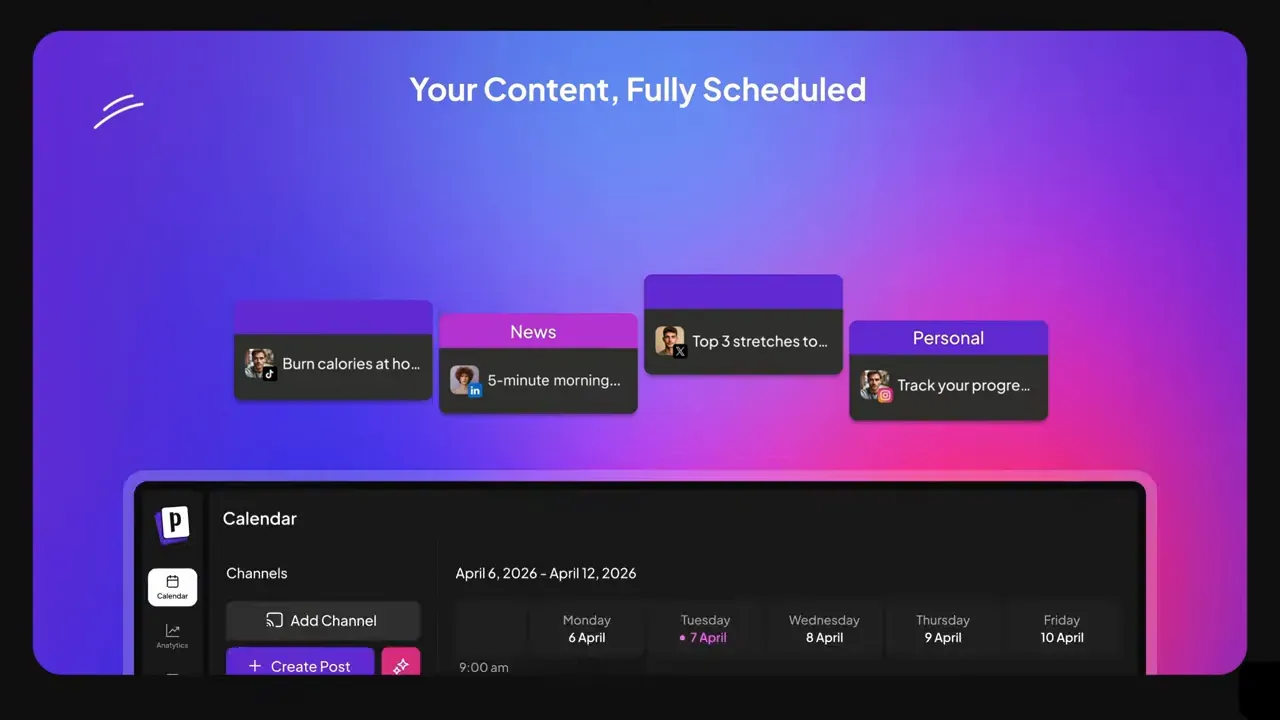
Interview with Nevo David, Founder of Postiz and Builder of an Agentic Social Media SaaS
Most advice about building an AI-powered launch system for creators gets stuck in the same loop: add AI, post vaguely about AI, wait for the algorithm to hand over a bag of money. Very elegant. Very useless.
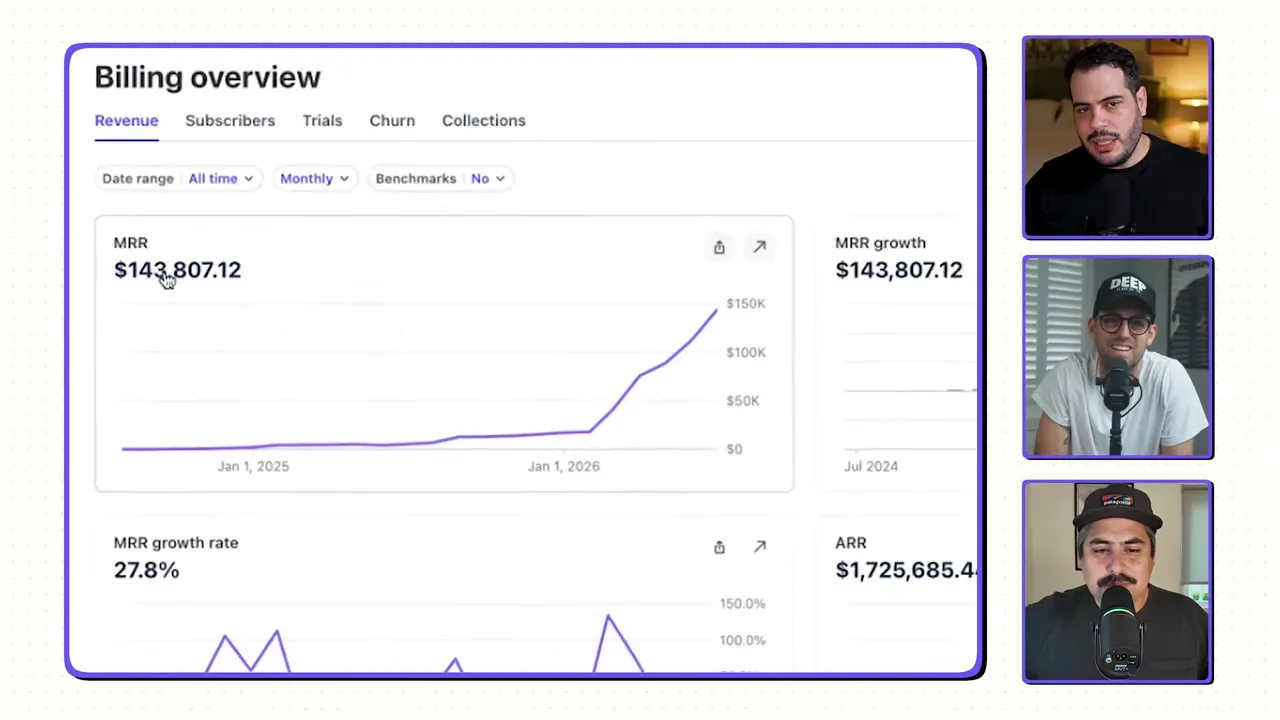
Nevo David took a different route with Postiz. He had already built a real social media scheduling SaaS with a real API, a real customer problem, and all the annoying operational baggage that comes with software people actually use. Then an agent trend arrived, his product was ready for it, and the business went from roughly $17,000 in monthly recurring revenue to more than $143,000 in four months.
The story is not really about getting lucky with a trend. It is about having useful infrastructure before attention arrives, turning a market signal into a repeatable marketing system, and refusing to let growth turn the product into a pile of broken buttons.
Table of Contents
- 📈 The Setup: From Social Scheduler to Agentic SaaS
- 🚀 The Growth: How Postiz Reached $143K MRR
- 🧠 The AI-Powered Launch System for Creators: Build Before the Trend
- 🔌 Building for Agents Without Making a Mess
- 🛠️ The Real Talk: Reliability Beats More Features
- 🔮 What Happens When Agents Can Buy Software?
- 🧪 The Build to Test Tonight
- ❓ FAQ
📈 The Setup: From Social Scheduler to Agentic SaaS
What was Postiz before the growth spike?
Nevo built Postiz as a social media scheduling tool that could publish content across more than 30 platforms. At its core, the product handled the tedious operational layer: connecting channels, creating posts, scheduling them, and making sure content went out where and when it was supposed to.
That is a reasonable SaaS business. It also has a predictable problem. Scheduling content manually still asks customers to show up constantly, write material, edit it, choose channels, and press buttons. A tool can be good and still become another job on the customer’s list.
What changed when Postiz became agentic?
Postiz shifted from a standard scheduling dashboard into a tool that AI agents could use. Rather than logging in and manually preparing every post, someone could use tools such as Claude, ChatGPT, OpenClaw, or Hermes Agent to generate and schedule social content through Postiz.
That is the important distinction. The product did not simply bolt a chatbot onto the dashboard and call it innovation, which is how a surprising number of AI features end their brief, expensive lives. Postiz became part of an automated workflow. An agent could take source material, create posts, choose timing, and send the work to the scheduler.
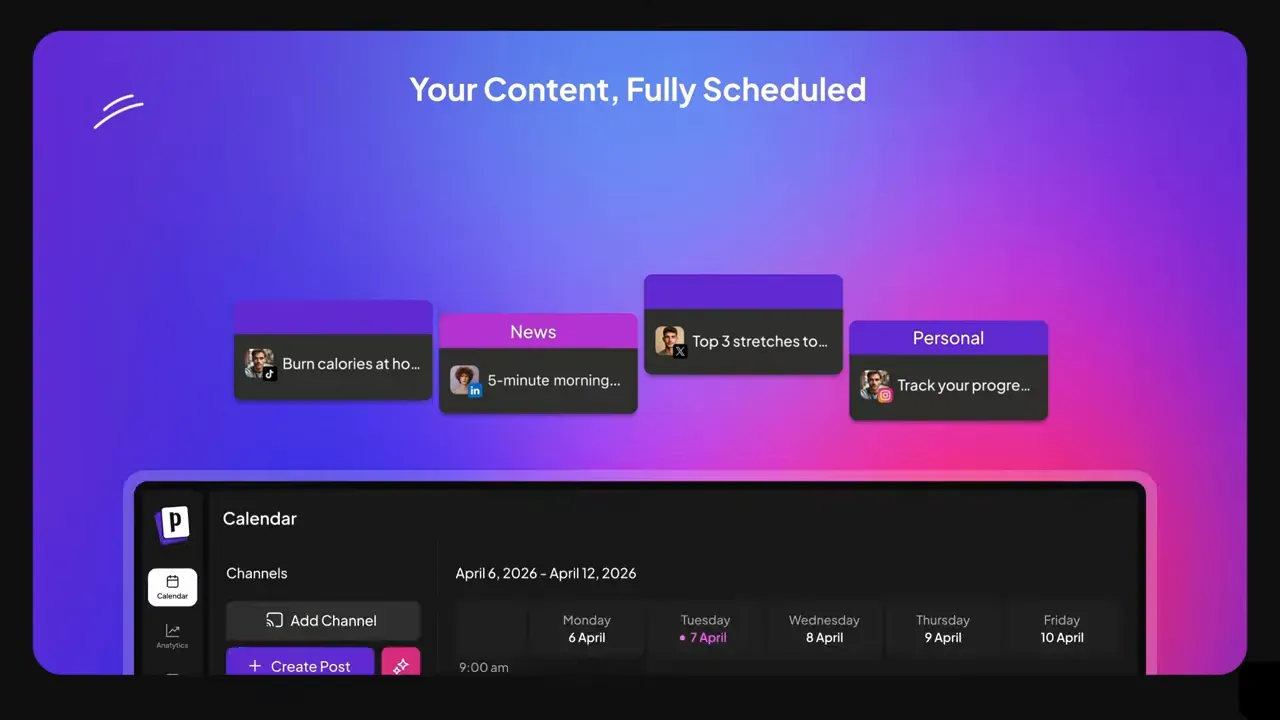
For solo builders and creators, this is what an AI funnel builder should mean in practice: fewer manual steps between an idea, a piece of source content, and consistent distribution. The agent does not replace strategy. It replaces the repetitive setup work that usually dies somewhere between “I should post more” and “I will do it next week.”
🚀 The Growth: How Postiz Reached $143K MRR
How fast did the business actually grow?
Postiz took about a year and a half to reach roughly $21,000 MRR. Then the business accelerated sharply. Its public revenue milestones showed about $41,000 MRR in February, $76,000 in March, $80,000 in April, $109,000 in May, and more than $140,000 by late June.
Nevo reported that the product reached 4,271 subscribers and that monthly churn fell to 13.7%, down from levels around 26% to 28% before the agentic pivot. That does not make every AI workflow a churn cure. It does show what happens when automation makes the product easier to keep using.
What triggered the jump?
A product called OpenClaw was gaining attention. Nevo saw the trend and made Postiz compatible with it. A few days later, Oliver Henry shared how he was using OpenClaw and Postiz to automate TikTok marketing for his app, Snuggly.
The article received 7.2 million views on X. That single distribution event drove around 700 concurrent Postiz trials per day, continuously. A second article also performed strongly, reaching roughly 1.5 million views.
That was the spark. But sparks do not build businesses. They just make it very obvious which parts of the room are flammable.
🧠 The AI-Powered Launch System for Creators: Build Before the Trend
What did Nevo do after seeing the OpenClaw signal?
He did not treat Oliver Henry’s viral post as a one-time lottery ticket. He reverse-engineered it. Nevo wrote his own article explaining how to use OpenClaw with Postiz. With only around 200 followers, that article reached about half a million views. Another article reached a similar number.
He noticed that X was functioning more like an interest platform than a pure follower platform. When a topic had active demand, the platform could distribute useful content about that topic to people who cared about it, even if the author did not have a massive audience.
Long-form X articles appeared to perform especially well because they held attention longer than normal posts. So Nevo leaned harder into the format while the topic was hot.
What was the actual marketing playbook?
The move was refreshingly practical:
- Identify an emerging topic with real attention. OpenClaw was not just a buzzword. Builders were actively discussing how to use it.
- Publish useful implementation content. The articles explained workflows, not vague opinions about the future.
- Find the people already distributing related content. Nevo examined the activity around high-performing posts and articles.
- Pay for relevant reposts. He contacted influencers and paid for promotion, typically spending between $60 and $350 for a repost.
- Stack distribution around each new article. Instead of publishing and praying to the feed gods, he had multiple creators repost the content.
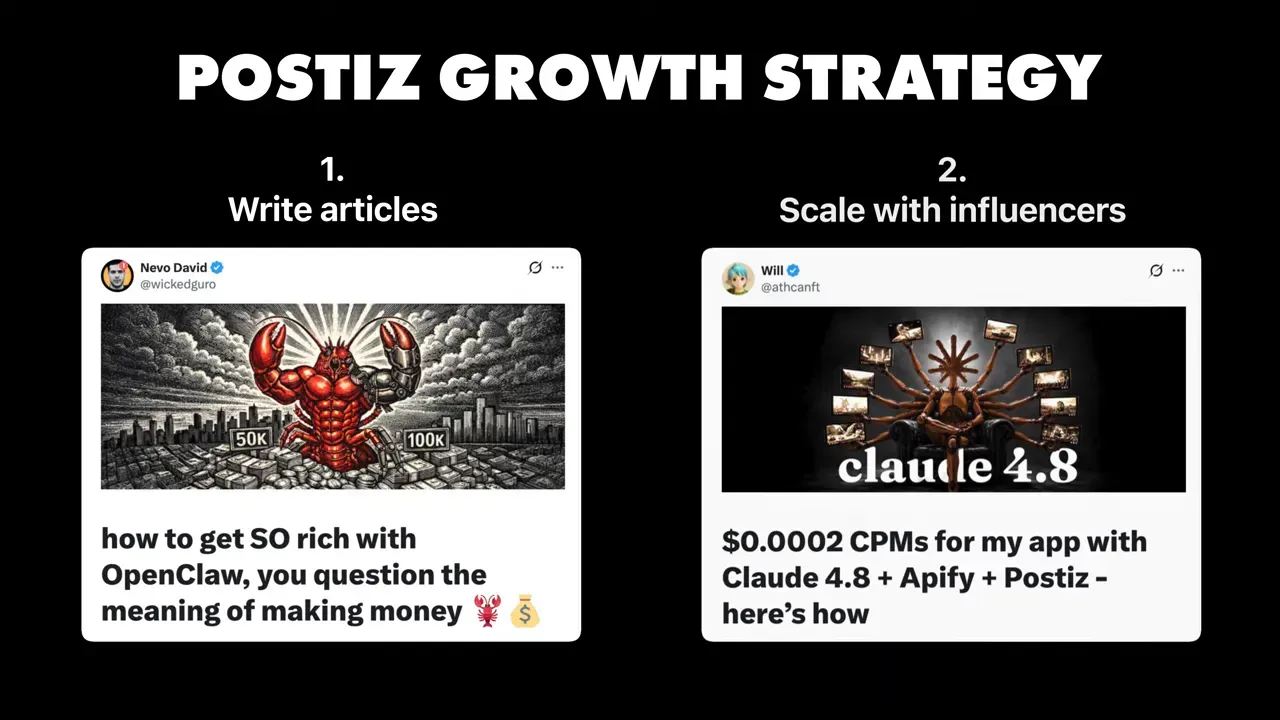
The expensive part was not the idea. It was being willing to test paid distribution once the business had enough revenue to support it. Early on, a few hundred dollars for a repost can feel absurd. At scale, it can be a measurable acquisition channel rather than a random expense.
What should a solo builder copy from this?
Copy the sequence, not the surface-level trend. The useful version looks like this:
- Build something that solves a problem without AI first.
- Give that product an API.
- Make it legible to agents and developers.
- Watch for adjacent behavior that is already growing.
- Publish the clearest guide to connecting that trend to the existing product.
- Put distribution behind the guide when there is evidence it resonates.
Trying to build “an agentic thing” with no existing problem, no product, and no distribution is just trend hopping with better typography. Postiz already had a useful scheduling product. The agent layer made that product more useful at the precise moment the market cared.
🔌 Building for Agents Without Making a Mess
What should SaaS founders build for AI agents?
Nevo’s advice is blunt: almost any SaaS should have an API. The next step is to take the public API documentation, turn it into an accessible Markdown file, and make it easy for agents to understand and use.
Postiz made its tools agent-ready, then listed the relevant documentation in marketplaces associated with tools such as Claude and ChatGPT. That created another source of traffic and made the product easier to discover in agent-driven workflows.
A practical agent-readiness checklist looks like this:
- Add a clear public API for the job the product already does well.
- Export the key API instructions as a clean Markdown file.
- Explain authentication, inputs, outputs, errors, and common workflows plainly.
- Make it obvious which actions are safe to automate.
- Publish the documentation where agent builders can find it.
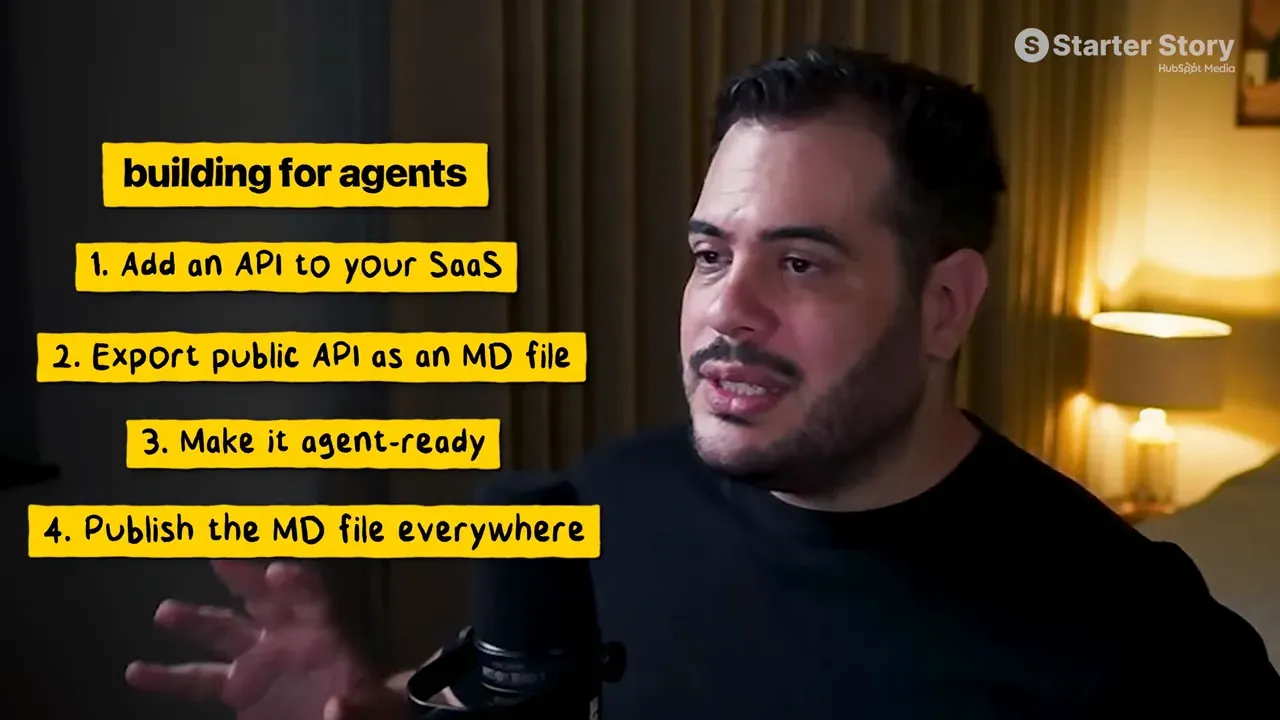
This is not a demand to rebuild every product around autonomous software. The agent audience is still early and relatively small. But it is an audience that is actively forming habits, choosing tools, and building workflows. Being one of the reliable options early matters.
Why did agent features reduce churn for Postiz?
Before the pivot, a Postiz customer had to repeatedly do the content work themselves. They needed to open the app, write posts, revise them with AI, decide on formats, and schedule the results. That is friction, and friction is where subscriptions go to quietly die.
After the pivot, a customer could provide a source of content to an LLM and have a week of marketing material generated and scheduled. The product became more embedded in a recurring workflow. Customers were no longer paying for a place to click. They were paying for work to keep moving.
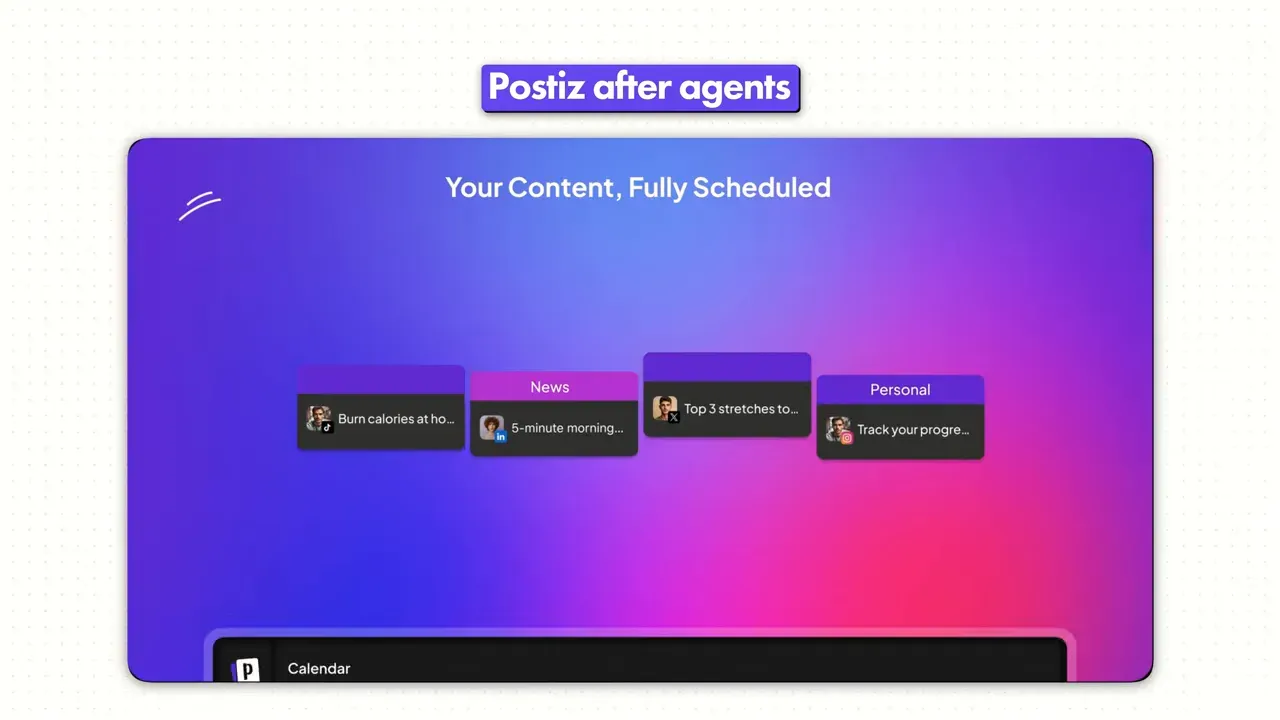
That is the retention lesson for anyone trying to launch with AI tools: automate a recurring action that customers already struggle to sustain. Do not automate a novelty that gets used twice and then forgotten in a tab cemetery.
🛠️ The Real Talk: Reliability Beats More Features
What changed operationally once the revenue grew?
More revenue created room to spend on marketing and hire help. Nevo hired two people, one for support and one for development. At around $17,000 MRR, that kind of hiring was difficult. At more than $100,000 MRR, it became possible to invest in the business instead of personally holding every loose wire in place.
But the biggest priority was not adding more features. It was making Postiz reliable.
Why stop building features during growth?
Postiz supports more than 30 social media channels. Every new feature adds more opportunities for things to break, and broken automation is worse than no automation. If a scheduling tool fails unpredictably, customers have no reason to trust it with their marketing workflow.
Nevo’s approach was simple: pause feature expansion and make the existing product work properly. The SaaS products that win, especially in agentic workflows, will be the ones that do not break when an agent depends on them.
It is not glamorous. Nobody rushes to post “we fixed boring edge cases in our integration layer” on social media. But reliability is the feature that allows every other feature to matter.
🔮 What Happens When Agents Can Buy Software?
What is Nevo expecting from the next stage of agentic SaaS?
Nevo expects a major unlock when agents can complete purchases themselves. Today, there is usually still a human in the loop. An agent may identify a tool, recommend it, or begin an onboarding flow, but a person still has to approve a checkout and make the payment.
If agent payments become standard, an agent could identify the right tool for a task, purchase access, and include that tool in an automated workflow. That could change how products are discovered and bought.
For founders, the immediate takeaway is less dramatic: make the product easy for agents to evaluate, easy to integrate, and reliable enough to recommend. Nobody knows exactly how agent-led purchasing will unfold. The current space is still a bit of a wild west, only with more API keys.
🧪 The Build to Test Tonight
What is the smallest useful experiment for a builder with an existing SaaS?
Nevo’s story points to one clean test. Take the product’s most valuable repeatable action and make it usable outside the interface.
- Write down the one task customers repeat every week.
- Check whether an API can perform that task.
- Create a simple Markdown guide that shows an agent how to do it.
- Use one real content source or operational input to test the flow.
- Document the result in a useful article tied to a live conversation in the market.
That is a workable solo builder tech stack approach. It does not require inventing a new category, buying a $97 course full of arrows, or pretending every product needs a swarm of artificial employees. It requires taking an existing job and making it easier to complete consistently.
The broader lesson from Postiz is straightforward: build the capability before the trend, market the capability when the trend arrives, and protect the product from breaking once demand shows up. That is a much sturdier AI-powered launch system for creators than hoping a chatbot badge does the work.
❓ FAQ
What is Postiz?
Postiz is a social media scheduling SaaS that supports publishing across more than 30 platforms. It evolved from a manual scheduling tool into an agentic product that can work with AI tools and agents to generate and schedule content.
How did Postiz grow from $17K to $143K MRR?
The growth followed an agentic product pivot, viral long-form articles about OpenClaw workflows, and paid repost distribution through relevant influencers. The product was already solving a real scheduling problem before the trend created attention.
Should every SaaS add AI agents?
Not automatically. The useful question is whether an agent can remove recurring manual work for customers. If the agent feature makes the product more reliable, more embedded in a workflow, and easier to use repeatedly, it may improve retention. A decorative AI feature probably will not.
Why is API documentation important for agentic SaaS?
Agents need clear instructions for how to use a product. A well-documented public API and a clean Markdown reference help agents and their builders understand available actions, authentication, expected inputs, and safe workflows.
What is the most important scaling lesson from Postiz?
Reliability comes before feature volume. Once a SaaS becomes part of an automated workflow, broken integrations and unstable behavior quickly destroy trust. Fix the existing product before expanding the feature list.
This article was inspired by this amazing video I Grew My SaaS From $17K to $143K MRR in 4 Months. Check out more from their awesome channel.