
Interview with Tomer, the Builder Who Localized an AI Calorie App to $80K a Month

Original ideas are wildly overrated. Not because originality is bad, but because most solo builders use it as a very expensive procrastination device. They spend six months trying to invent a market category, then act surprised when nobody understands the landing page.
Tomer took the less glamorous route. He found a proven AI calorie tracking app, built a version for Israel in Hebrew, adapted it to local eating habits and content, then built distribution around it. Within roughly a year of launch, CalBuddy was bringing in more than $80,000 per month.
This is not a story about pushing a button and getting rich because AI exists. It is a practical case study in creating an AI-powered launch system for creators and solo builders: validate demand somewhere else, localize where there is an actual gap, ship the useful version, and make customer acquisition the real product work.
Table of Contents
- 🧠 Why an Unoriginal Idea Was the Smart Move
- 🛠️ Building the First Version Without Becoming a Developer
- 🎯 The AI-Powered Launch System for Creators Starts With Validation
- 📈 Growth: Start With the Channel That Fits the Market
- 🤝 Influencers as Partners, Not Renting Posts
- 🧱 The Real Talk: Build What the Market Lets You Build
🧠 Why an Unoriginal Idea Was the Smart Move
What made a localized calorie tracker worth building?
Tomer was working in marketing for other businesses and found the work increasingly disconnected from what he wanted to build. He was looking for a product of his own when he came across Cal AI, a US app that uses a food photo to estimate calories and macros.
The important observation was not, “Nobody has built this before.” It was the opposite: the category had already been validated. Cal AI had shown that people wanted the core experience. But a successful app in the United States is not automatically embedded in another market, especially where language, food culture, and local media habits are different.
That created the opening for CalBuddy: an AI calorie tracker designed specifically for the Israeli market in Hebrew. A user takes a photo of a meal, and the app returns calorie and macro estimates within seconds.
The product category mattered, too. Israel is a smaller market, so Tomer did not want to localize a tiny niche with a tiny ceiling. Fitness and nutrition are broad, durable categories. People everywhere eat, exercise, diet, stop dieting, restart dieting on Monday, and generally create plenty of demand for tools that reduce friction.
Is this just copying another app?
That is the lazy critique, and it misses how markets work. There are already countless calorie and fitness apps in app stores. Nobody seriously assumes every restaurant is invalid because another restaurant also sells food.
Tomer did not make a one-to-one clone. The core interaction is similar because the user problem is similar: take a photo, get nutrition information. The localization happens in the language, food context, brand, creative direction, and distribution.
That is the larger takeaway. A product can be technically familiar while being commercially distinct. If the app understands the language people use, the food they recognize, and the media they trust, it is not competing as a generic import.
🛠️ Building the First Version Without Becoming a Developer
How did Tomer build CalBuddy without a traditional engineering background?
Tomer had some coding exposure from high school and self-study, but he was not a professional developer. When Cursor was newly available, he treated it as an experiment: could AI-assisted coding actually turn an idea into working software?
About two weeks after starting, he had a working version with the core app features. From the first line of code to a live App Store release took around two months.
The catch, because there is always a catch, was not mainly writing the code. The slow part was Apple. Getting into the developer program and moving through App Store review created the real delay. This is a useful planning note for anyone trying to launch with AI tools: the software may move quickly, but platform approvals do not care about your momentum.
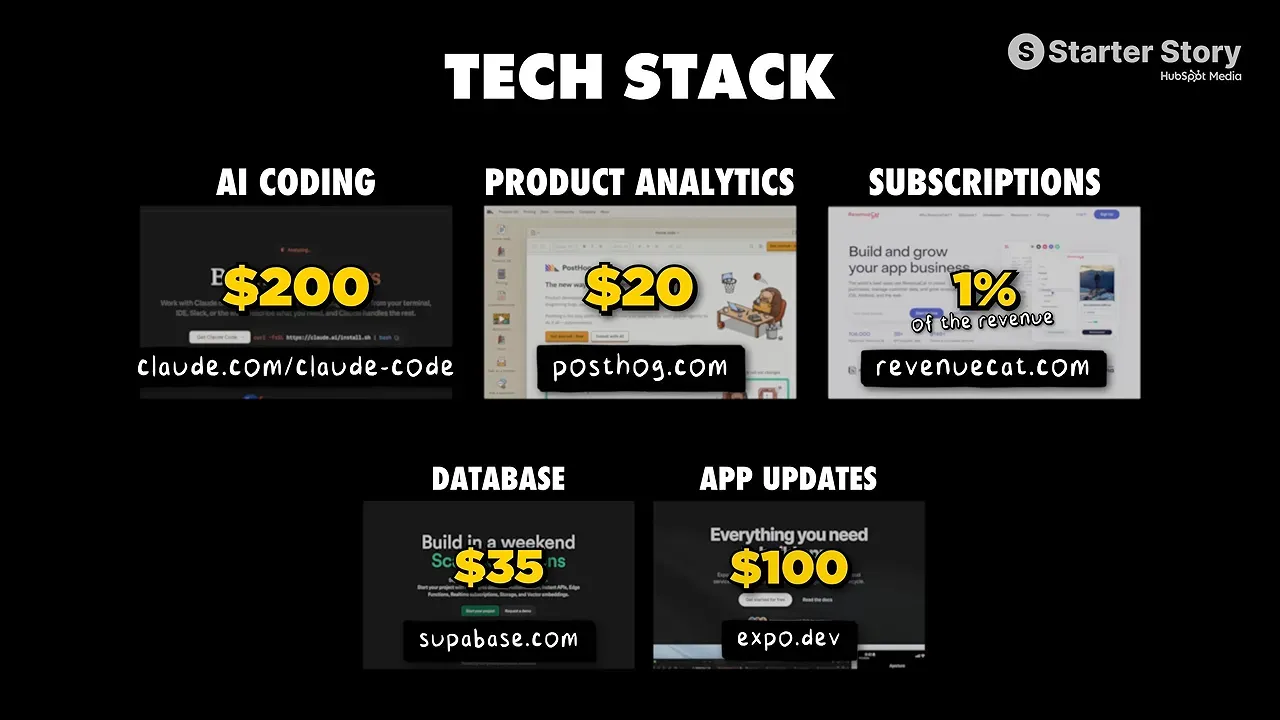
What did the solo builder tech stack look like?
The stack was straightforward and intentionally unromantic. It supported building, measuring, subscriptions, storage, and updates. No twelve-tool operating system held together by prayers and recurring invoices.
- Claude: AI coding and agents across the business, about $200 per month.
- PostHog: product analytics, about $20 per month.
- RevenueCat: subscription management.
- Supabase: database and storage, about $35 per month.
- Expo: in-app updates, about $100 per month.
This is what a useful solo builder tech stack looks like: tools attached to a job. The point is not collecting no-code startup tools until the dashboard resembles an aircraft cockpit. The point is getting a usable app into the hands of people and knowing whether it is working.
🎯 The AI-Powered Launch System for Creators Starts With Validation
What should a builder look for when localizing a proven app?
Tomer’s selection filter was simple: choose a category that is proven, broad enough for the local market, and personally understandable. The idea was not to recreate every feature of the US product. It was to identify the smallest version that delivers the valued outcome in a new context.
A practical research process looks like this:
- Find a proven winner. Look for apps with visible demand, clear monetization, and an understandable customer problem.
- Check the local gap. Is there a well-known equivalent in the target country, city, language, or community? If not, why not?
- Choose a large enough niche. Smaller markets require larger categories. A niche inside a niche inside a niche is usually a hobby with invoices.
- List the localization work. This includes language, cultural references, food, pricing, onboarding, design, content, and customer support.
- Build the core loop first. In CalBuddy’s case, that loop was taking a food photo and receiving calorie and macro information.
- Plan distribution before polishing edge cases. A perfect app with no acquisition channel is just an expensive personal project.
The framework works beyond mobile apps. It can apply to creator products, workflow tools, marketplaces, services, and AI funnel builder concepts. The useful question is not “Has this been done?” It is “Has this been done well for these people, in this context, through the channels they actually use?”
Where did CalBuddy actually differentiate?
Tomer is direct about this: the product was not radically different from other AI calorie trackers. The defensible part was brand and distribution.
That matters because the technical feature set is becoming easier to reproduce. If another builder can create a similar app in a few weeks with AI coding tools, code is not much of a moat by itself. Lower customer acquisition cost is more valuable. If a business can acquire users for half of what competitors pay, it generates more cash flow, and that cash flow can fund more growth.
In plain English: being cheaper to discover is often more valuable than being slightly prettier.
📈 Growth: Start With the Channel That Fits the Market
How did CalBuddy grow from launch to about $20K per month?
Tomer came from marketing, so he began with the question many builders postpone until after launch: which acquisition channel is most efficient for this market?
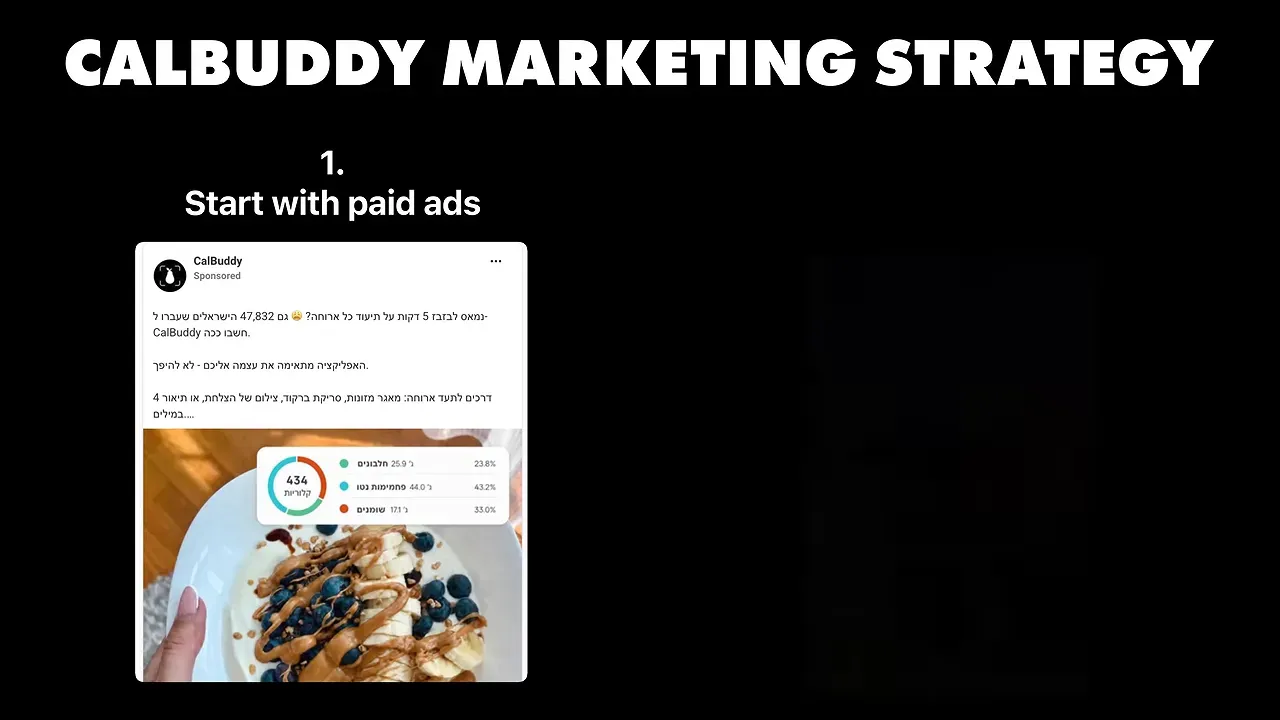
UGC, influencers, paid ads, and SEO can all work. The correct choice depends on the audience and economics. In Israel, paid social ads were the best early channel because CPMs were materially lower than in the United States. That made it possible to test and scale without needing a massive pile of capital first.
He studied two things:
- The most viral content from comparable apps in the US.
- The most viral fitness and nutrition content in Israel.
Then he used those patterns to create localized ad creatives. Not random “Here is our app” graphics. Content shaped by what was already earning attention in the category and the local market.
That approach brought CalBuddy to roughly $20,000 per month in about four months. It is a good reminder that paid ads are not a substitute for positioning. They are an amplifier. If the creative, offer, and cultural fit are off, the ad platform will help burn money with impressive speed.
What is the practical paid-creative lesson here?
Research virality before making creative. Do not start from a blank canvas because blank canvases are where weak marketing goes to become “brand exploration.”
Instead, collect examples that already work in the category, identify recurring hooks and formats, then adapt them to the local audience and product truth. The goal is not to mimic every line. It is to understand what makes people stop, care, and take action.
For a builder trying to automate a funnel with AI, AI can speed up scripting, angle generation, and creative variations. It cannot tell you whether a local market finds a reference natural, funny, useful, or deeply embarrassing. That part still requires taste and research.
🤝 Influencers as Partners, Not Renting Posts
How did Tomer scale from $20K to more than $80K per month?
Once CalBuddy had traction, usage, and social proof, Tomer moved to influencer partnerships. The key was timing. He did not approach major personalities when the business was only an idea. He waited until the app was already generating around $20,000 monthly.
That changed the conversation. The business had evidence, users, and revenue. It was no longer asking someone famous to gamble on a mockup.
Instead of paying a large one-off fee for a story or reel, Tomer partnered with prominent influencers on a revenue-share arrangement tied to revenue from Israel. Their incentives were aligned: as the company made more, they made more. They also became recognizable faces associated with the brand, which is much harder for the next generic competitor to reproduce with a weekend of prompts.
What should an influencer partnership agreement include?
A revenue share is not a magical business spell. It needs operational structure. Tomer’s agreements were based on concrete work timelines and deliverables.
- The number of pieces of content required each month.
- The number of filming or recording days.
- Expected posting and production timelines.
- The revenue scope covered by the agreement.
The biggest practical lesson is to build proof before outreach. A major influencer or celebrity has more leverage when the product is hypothetical. Once a product has customer excitement and revenue, the founder has more room to negotiate terms that leave space for future partnerships and sustainable economics.
There is also a useful distinction here: paying for a post buys temporary reach. Building a partnership can create ongoing advocacy. If the partner benefits from the company’s long-term success, they have a reason to keep mentioning it outside the exact deliverables.
🧱 The Real Talk: Build What the Market Lets You Build
What is the biggest lesson from CalBuddy’s growth?
The lesson is not “copy apps.” That framing is too shallow to be useful. The lesson is to reverse engineer proven demand, then do the hard local work that makes the product relevant.
Tomer did not win because calorie tracking was novel. He won by pairing a proven core experience with the right market, a localized brand, lower-cost paid acquisition, and partnerships that made distribution durable.
It is also worth being honest about the result. One founder’s revenue is not a guarantee, and a proven category can still be a terrible fit if the local competition is entrenched, acquisition costs are ugly, or the audience simply does not care. The point is not to copy blindly. The point is to start from evidence instead of treating invention as a personality trait.
What advice would Tomer give a builder starting now?
Do not let unfamiliarity become the constraint. Building a business means encountering problems that look too technical, too operational, or too outside the job description. There will be setbacks. There will be systems that break. There will be approvals that take longer than building the thing they are approving, because naturally that is how it works.
The useful operating belief is simple: whatever comes up, it can be figured out. That does not mean pretending everything is easy. It means refusing to make personal uncertainty the bottleneck.
An AI-powered launch system for creators is not a stack of prompts pretending to be a business. It is a repeatable sequence: find validated demand, adapt it intelligently, ship the core value, measure usage, acquire customers efficiently, and build a brand that has a reason to exist.
That is worth testing tonight. Find one app succeeding elsewhere, identify one underserved local angle, and write down the smallest version that would be useful. No revolutionary idea required. Just a real problem, a reachable audience, and fewer excuses wearing little startup hats.
❓ Frequently Asked Questions
What is CalBuddy?
CalBuddy is an AI calorie tracking mobile app built for the Israeli market in Hebrew. It allows users to photograph meals and receive estimated calorie and macro information.
How long did it take Tomer to build the first version?
Tomer had a working version with the main features after around two weeks of AI-assisted coding. The journey from first line of code to an App Store launch took roughly two months, with Apple account approval and app review creating much of the delay.
Why did CalBuddy begin with paid ads?
Paid ads were efficient in Israel because CPMs were lower than in the US. Tomer studied viral content from comparable US apps and from Israel’s local fitness and nutrition market, then used those insights to create ad creative.
When should a founder approach influencers for a revenue-share partnership?
Tomer recommends building social proof first. Once an app has traction, happy users, and revenue, a founder has a stronger negotiating position and can approach larger influencers with evidence rather than a speculative idea.